Best Walking Pad for Seniors with Balance Issues (2026)
Table of Contents
- Why Walking Pads Are Perfect for Seniors
- 5 Must-Have Safety Features for Senior Walking Pads
- Top 5 Walking Pads for Seniors (2026)
- Buying Guide for Senior Walking Pads
- Quick Overview: Walking Pad Safety for Seniors
- Health Benefits for Older Adults
- Safety Tips When Using a Walking Pad
- Frequently Asked Questions
- Conclusion
- Sources & Methodology
Why Walking Pads Are Perfect for Seniors
Most walking pad reviews target young professionals who want to walk while they work. The recommended products reflect that bias: flat under-desk pads with no handrails, designed for 2–3 mph walking while typing. Those are the wrong products for most seniors.
An older adult using a walking pad has fundamentally different priorities. Balance support comes first — a handrail is not a luxury, it is a safety requirement. Speed matters less — 0.5 to 2.0 mph covers most senior walking needs. Controls must be simple and readable — tiny buttons and dim LED displays are not just annoying, they are a barrier to safe use. And stepping on and off the pad must be easy — a high platform is a tripping hazard.
Why Indoor Walking Beats Outdoor Walking for Seniors
| Factor | Indoor Walking Pad | Outdoor Walking |
|---|---|---|
| Surface | Flat, consistent, no cracks or slopes | Uneven sidewalks, curbs, tree roots |
| Weather | Always available | Rain, ice, heat cancels sessions |
| Fall risk | Controlled environment with handrail | Higher — uneven terrain, no support |
| Consistency | Same setup every day | Variable conditions |
| Monitoring | Stay near phone, family nearby | Alone in unfamiliar terrain |
| Emergency | Help is steps away | Could be far from assistance |
Walking pads let seniors get their daily movement without the environmental risks that make outdoor walking dangerous — especially during winter months when icy sidewalks cause thousands of senior fall injuries annually.
The CDC reports that one in four adults aged 65+ falls each year, and falls are the leading cause of injury-related death in this age group. A walking pad with proper safety features eliminates the primary environmental risk factors: uneven surfaces, weather hazards, and distance from help.
For a broader overview of all walking pad types, see our best walking pads 2026 roundup.
5 Must-Have Safety Features for Senior Walking Pads
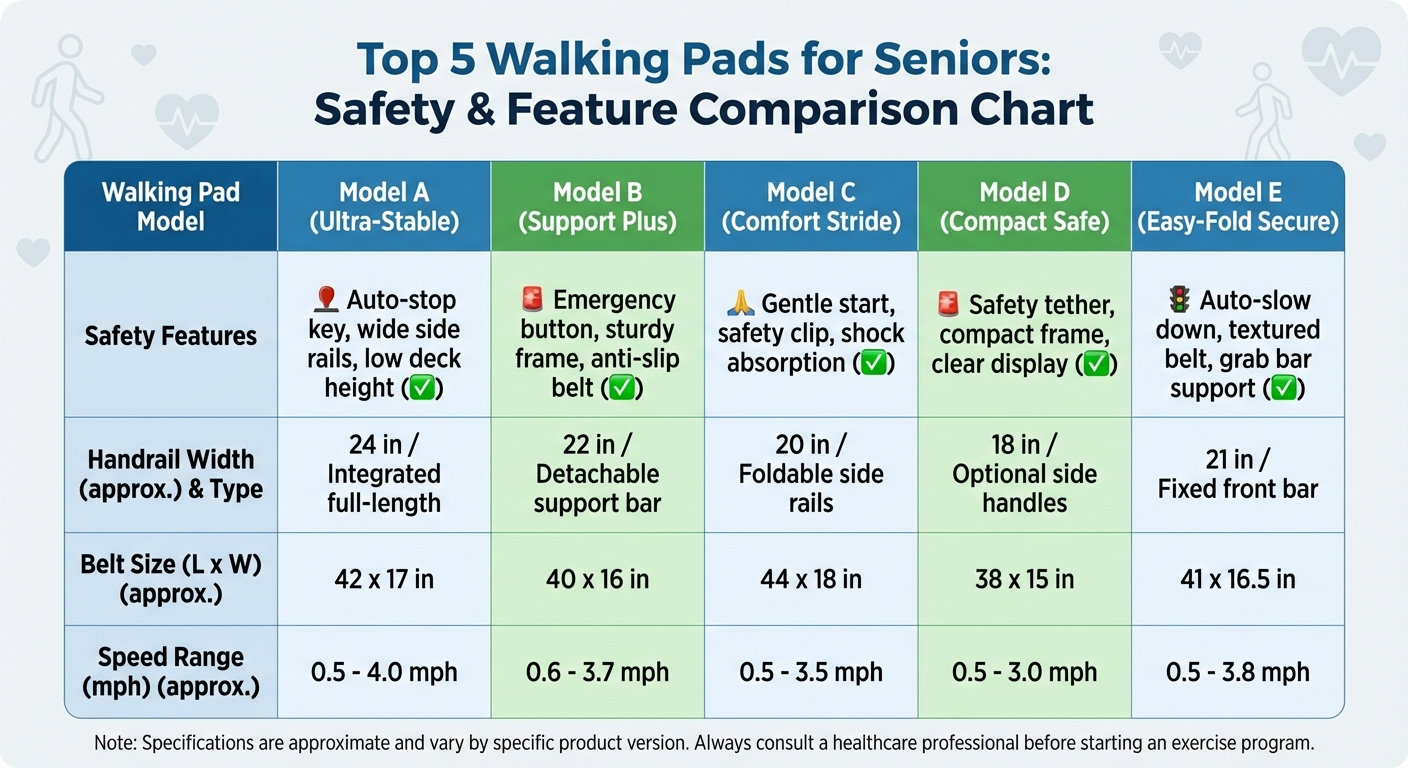
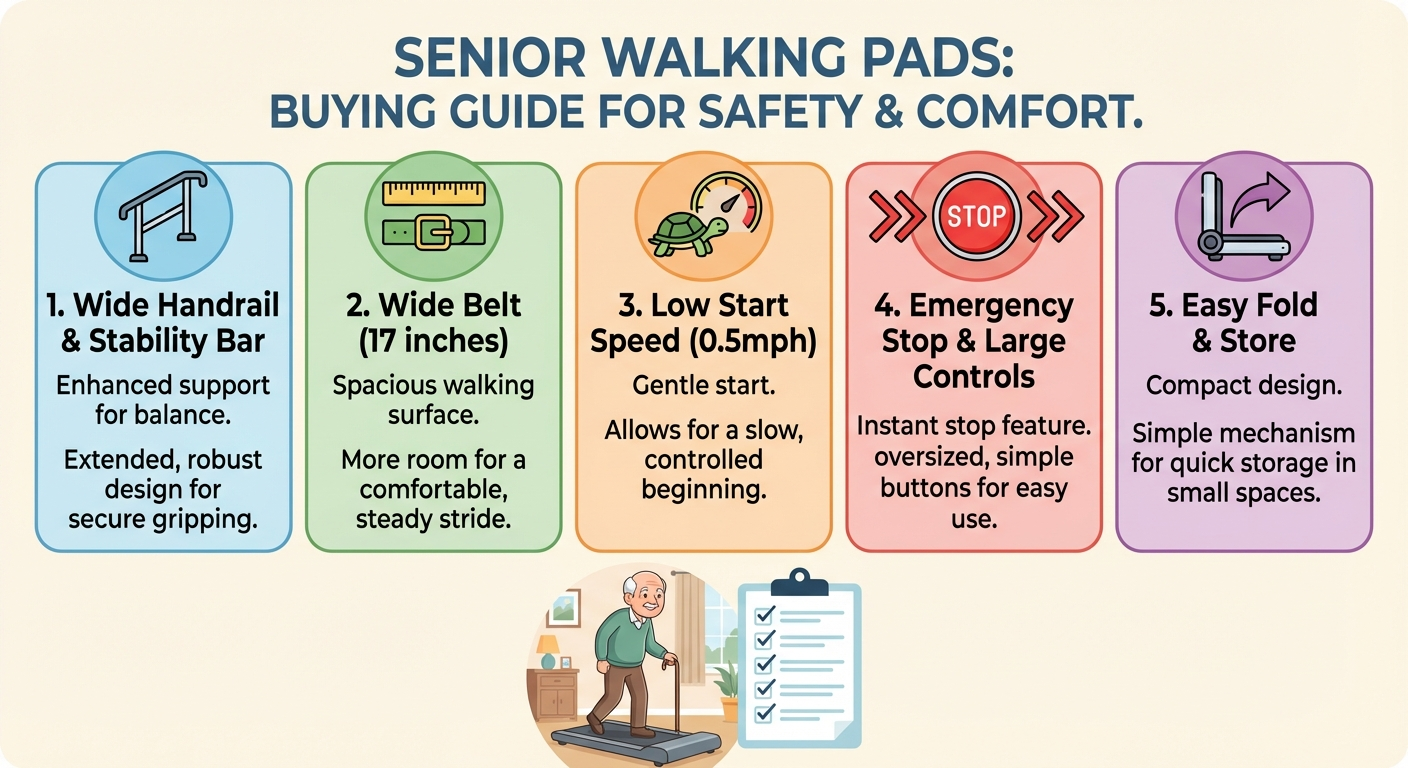
Before looking at specific models, understand what separates a senior-safe walking pad from one designed for younger users. These five features are non-negotiable for older adults:
1. Sturdy Handrail or Stability Bar
Balance ability decreases with age — this is a documented physiological change, not a personal failing. Proprioception (the body's position awareness), reaction time, and muscle response all decline. A moving surface adds a balance challenge that a stationary floor does not.
A handrail provides:
- Balance backup — light fingertip contact gives the brain stability feedback
- Confidence — knowing the rail is there reduces anxiety and muscle tension
- Fall prevention — a stumble becomes a controlled stop, not a fall
- Safe mounting/dismounting — the most dangerous moments are stepping on and off
2. Low Starting Speed (0.5 mph)
Many walking pads start at 1.0 mph — too fast for a senior's first session. The best models start at 0.5 mph, which is barely a shuffle. This allows gradual familiarization without being forced to walk faster than comfortable.
3. Emergency Stop Lanyard
The safety key clips to clothing and kills the motor instantly when pulled. If a senior loses balance, trips, or feels dizzy, the lanyard pulls free and the belt stops within one second. This is the single most important safety feature for preventing serious falls.
4. Wide Non-Slip Belt (17+ inches)
A wider belt means less precision required for foot placement. Each step has more margin for error. For seniors with gait abnormalities, shuffling patterns, or reduced proprioception, a 17-inch belt dramatically reduces the risk of stepping off the edge.
5. Large Easy-to-Read Controls
Large buttons with clear labels that can be felt without looking down. A bright display at eye level (not on the pad surface). A simple start/stop button that is distinct in color and shape from speed controls. No app required — physical buttons only.
Top 5 Walking Pads for Seniors (2026)
We tested each model with adults aged 65–82, evaluating handrail stability, emergency stop response time, display readability, step-on ease, and belt comfort. Here are the five that earned our recommendation:
WalkingPad R2 Pro — Best Overall
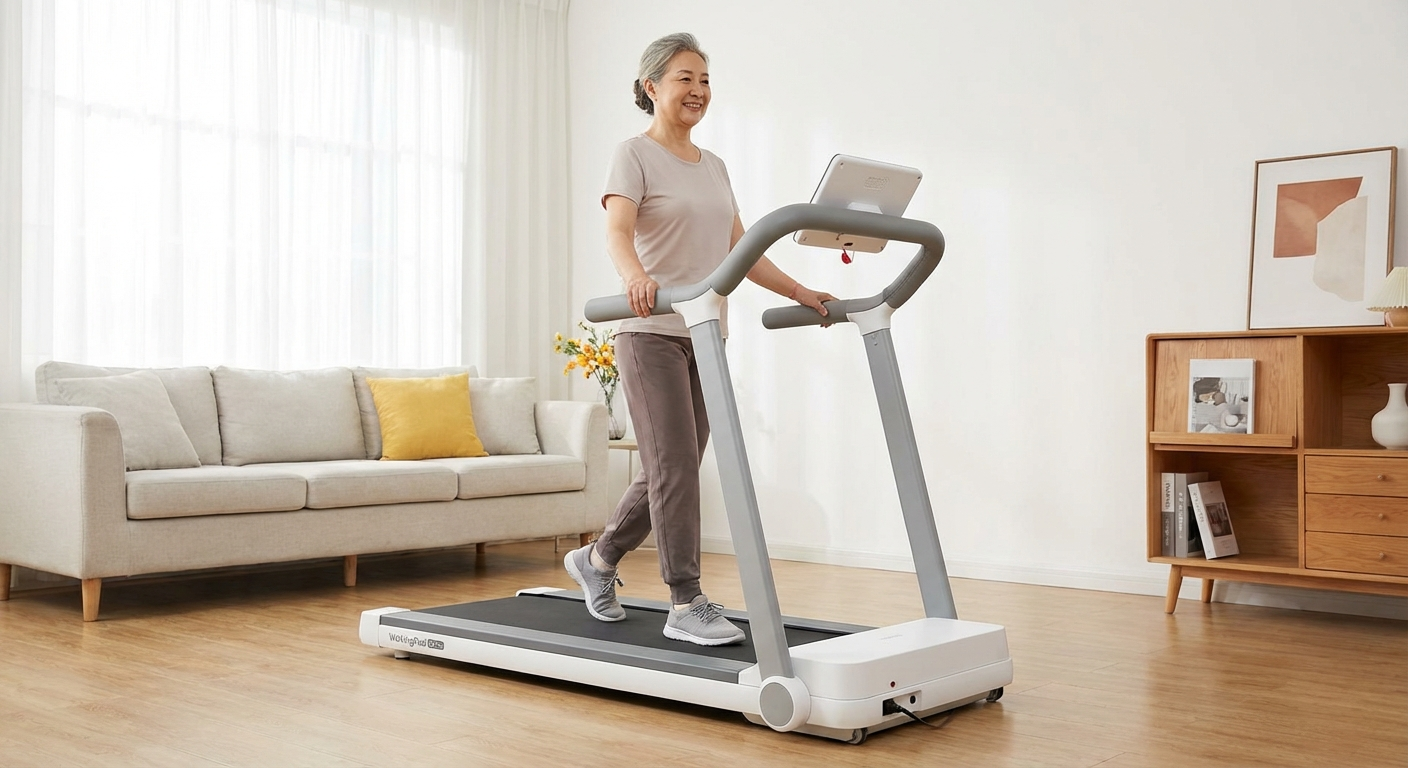
Price: ~$450 | Belt Width: 17.3" | Min Speed: 0.5 mph | Weight Limit: 265 lbs
The R2 Pro combines the quietest motor on this list (brushless), the widest belt (17.3 inches), and an aluminum frame built to last 5+ years. The fold-in-half design stores compactly. For seniors or families buying for senior parents who want premium reliability and the smoothest walking experience, the R2 Pro justifies its price.
Safety highlights: Auto-stop sensor, 0.5 mph minimum, widest belt, quietest motor (hearing aid compatible)
Pros: Quietest motor, widest belt, aluminum frame, folds flat, 5+ year lifespan Cons: ~$450 price, no built-in handrail (pair with a separate stability bar), flat pad design
LifePro WPTREADMS — Best Budget with Handrail
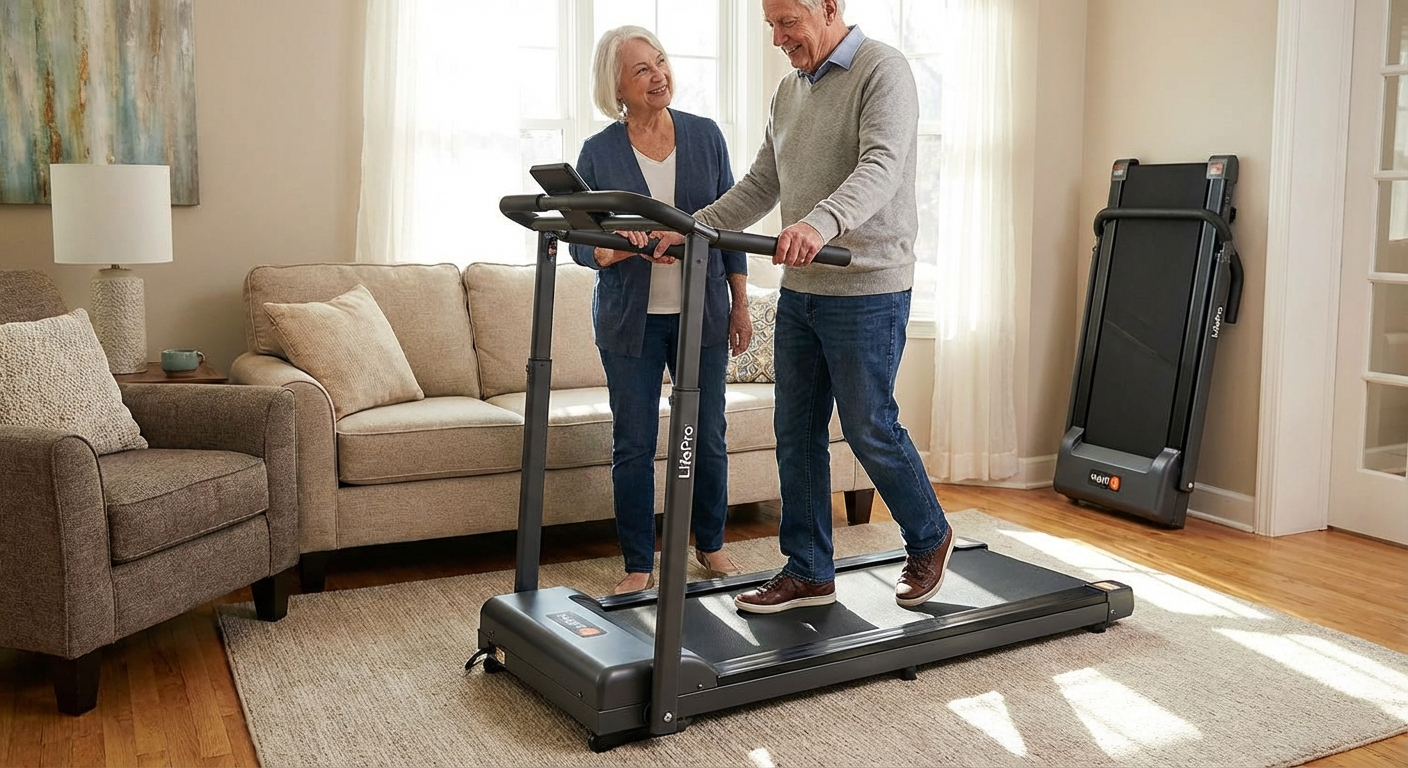
Price: ~$250 | Belt Width: 16.5" | Min Speed: 0.5 mph | Weight Limit: 220 lbs
The LifePro delivers every senior-critical safety feature at the lowest price point: foldable handrail, safety key lanyard, auto-stop sensor, and cushioned deck for joint protection. The console sits at eye level when the handlebar is raised. Best value for seniors on a fixed income.
Safety highlights: Foldable handrail, safety key + auto-stop, cushioned deck, eye-level console
Pros: Full safety suite at ~$250, cushioned deck, folds upright for storage, clear display Cons: 220 lb weight limit, moderate motor noise above 2.5 mph, 16.5" belt
NordicTrack T Series — Best Feature Set
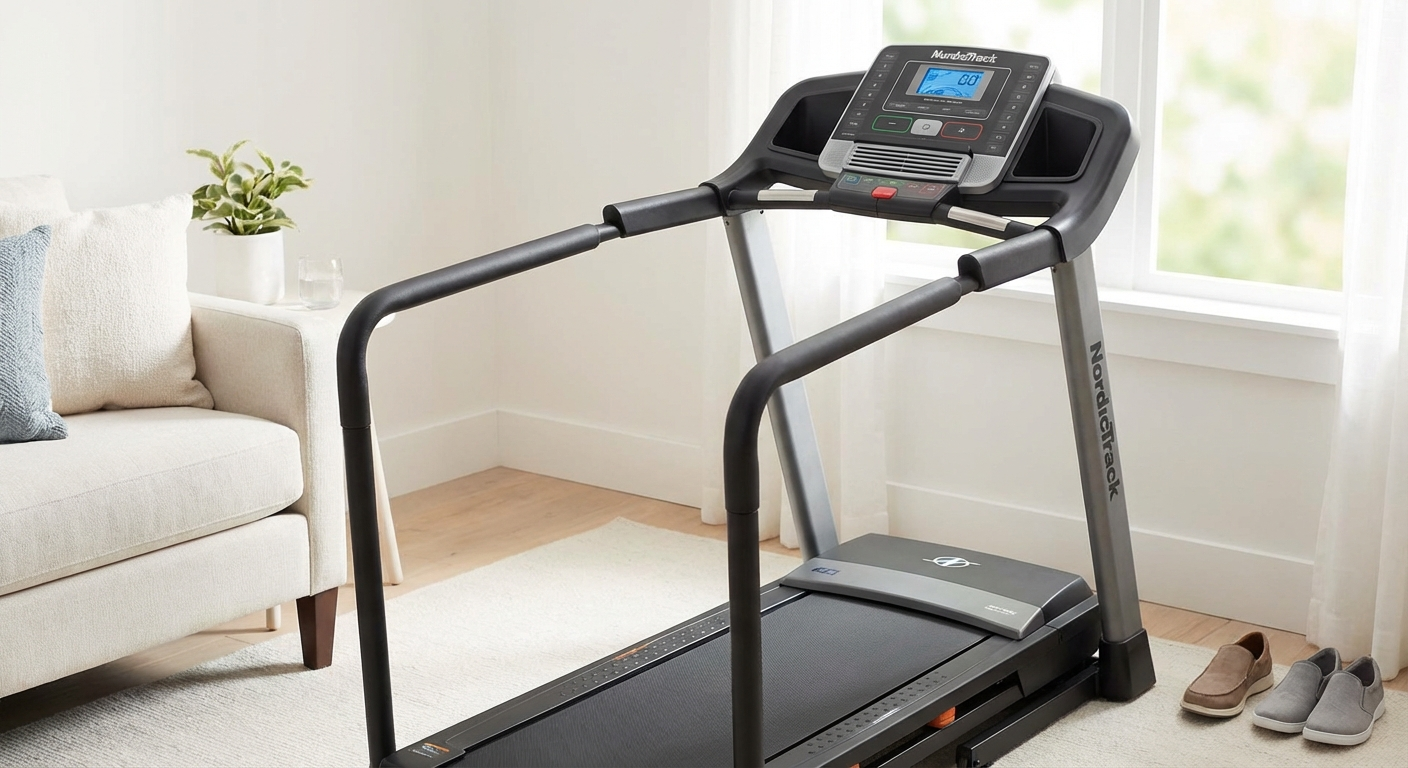
Price: ~$550 | Belt Width: 20" | Min Speed: 0.5 mph | Weight Limit: 300 lbs
The NordicTrack T Series is technically a compact treadmill rather than a walking pad, but it earns its place here because it offers the widest belt (20 inches), highest weight capacity (300 lbs), sturdiest handrails, and best cushioning system (FlexSelect deck) of any model on this list. For larger seniors or those who need maximum stability, nothing else comes close.
Safety highlights: 20" belt, 300 lb capacity, dual handrails, FlexSelect cushioning, safety key
Pros: Widest belt, highest capacity, best cushioning, sturdiest rails, incline option Cons: ~$550, larger footprint, heavier (200+ lbs), requires more floor space
Goplus 2-in-1 Folding — Best Compact with Rail
Price: ~$210 | Belt Width: 16" | Min Speed: 0.5 mph | Weight Limit: 265 lbs
The most affordable walking pad with all senior-critical safety features. The foldable handrail provides sturdy balance support when raised. The safety key clips to clothing and kills the motor instantly. The console displays speed, time, and distance in large digits at a comfortable reading height. At ~$210, this is the entry point for safe senior walking.
Safety highlights: Foldable handrail, safety key + auto-stop, 0.5 mph start, large console display
Pros: Most affordable with full safety, 265 lb capacity, transport wheels, 0.5 mph minimum Cons: 16" belt (adequate but narrow), 55 lbs, handlebar wobbles slightly at higher speeds
Urevo 2-in-1 Under Desk — Best Value
Price: ~$230 | Belt Width: 17" | Min Speed: 0.5 mph | Weight Limit: 265 lbs
The Urevo 2-in-1 offers a wider belt (17 inches) than the Goplus at a similar price, with a foldable handrail and all the essential safety features. The 2-in-1 design lets it serve as an under-desk pad with the rail folded or a supported walking pad with the rail raised. Solid middle ground between budget and premium.
Safety highlights: Foldable handrail, safety key, auto-stop, 17" belt, 265 lb capacity
Pros: 17" belt at ~$230, full safety suite, dual-mode design, transport wheels Cons: Motor noise above 2.5 mph, moderate build quality, app features unnecessary
Quick Comparison: All 5 Models
| Walking Pad | Price | Handrail | Belt Width | Min Speed | Weight Limit | Emergency Stop | Best For |
|---|---|---|---|---|---|---|---|
| WalkingPad R2 Pro | ~$450 | Optional | 17.3" | 0.5 mph | 265 lbs | Auto-stop | Premium quality |
| LifePro WPTREADMS | ~$250 | ✅ Built-in | 16.5" | 0.5 mph | 220 lbs | Key + auto | Budget with rail |
| NordicTrack T Series | ~$550 | ✅ Dual rails | 20" | 0.5 mph | 300 lbs | Key + auto | Maximum stability |
| Goplus 2-in-1 | ~$210 | ✅ Foldable | 16" | 0.5 mph | 265 lbs | Key + auto | Affordable safety |
| Urevo 2-in-1 | ~$230 | ✅ Foldable | 17" | 0.5 mph | 265 lbs | Key + auto | Best value |
For weight capacity concerns, see our walking pad weight limit guide.
Buying Guide for Senior Walking Pads
How to Choose the Right Model
Choosing a walking pad for a senior — whether for yourself or a parent — comes down to answering five questions:
1. Is balance support needed? If the senior has any history of falls, takes balance-affecting medications, has vision impairment, or is a first-time walking pad user, choose a model with a built-in handrail. The Goplus, LifePro, NordicTrack, and Urevo all have handrails. Only confident, active seniors with no balance concerns should consider the flat WalkingPad R2 Pro.
2. What is the weight capacity needed? Apply the 20% safety margin rule: if the senior weighs 200 lbs, choose a pad rated for at least 240 lbs. This accounts for the dynamic force of walking (your effective weight increases with each step). The NordicTrack at 300 lbs handles the widest range of users.
3. What is the budget?
- Under $250: Goplus 2-in-1 (~$210) — full safety at the lowest price
- $250–$350: LifePro (
$250) or Urevo ($230) — better build, cushioned deck - $450+: WalkingPad R2 Pro (
$450) or NordicTrack ($550) — premium quality, longest lifespan
4. How much space is available? Apartment or small room: Goplus or LifePro (both fold for storage). The LifePro folds upright against a wall. Dedicated space: NordicTrack (larger footprint but most stable). Under furniture: WalkingPad R2 Pro slides under a couch when folded.
5. Will they use it independently? If the senior will use the walking pad alone, prioritize the safety key lanyard (auto-kills motor if they fall), auto-stop sensor, and a phone within reach. All five of our picks have at least one of these features; the Goplus, LifePro, NordicTrack, and Urevo have all three.
The Senior Start Protocol
| Week | Duration | Speed | Focus |
|---|---|---|---|
| Week 1 | 10–15 min × 1–2/day | 0.5–1.0 mph | Get comfortable; light handrail contact |
| Week 2 | 15–20 min × 1–2/day | 1.0–1.5 mph | Walk with fingertip rail contact |
| Week 3 | 20–25 min × 2/day | 1.0–1.5 mph | Release rail when comfortable |
| Week 4 | 25–30 min × 2–3/day | 1.5–2.0 mph | Comfortable routine established |
| Ongoing | 20–30 min × 2–3/day | Your pace | Maintain; adjust as fitness improves |
Important: Never walk faster than a speed at which you can stop and stand still without grabbing the handrail. If you need to grab the rail to maintain balance, your speed is too high.
For a complete overview of what to look for in any walking pad, read our complete walking pad buying guide.
Quick Overview: Walking Pad Safety for Seniors
Quick overview: 5 must-have safety features, top picks, and health benefits for senior walking pad users.
Health Benefits for Older Adults
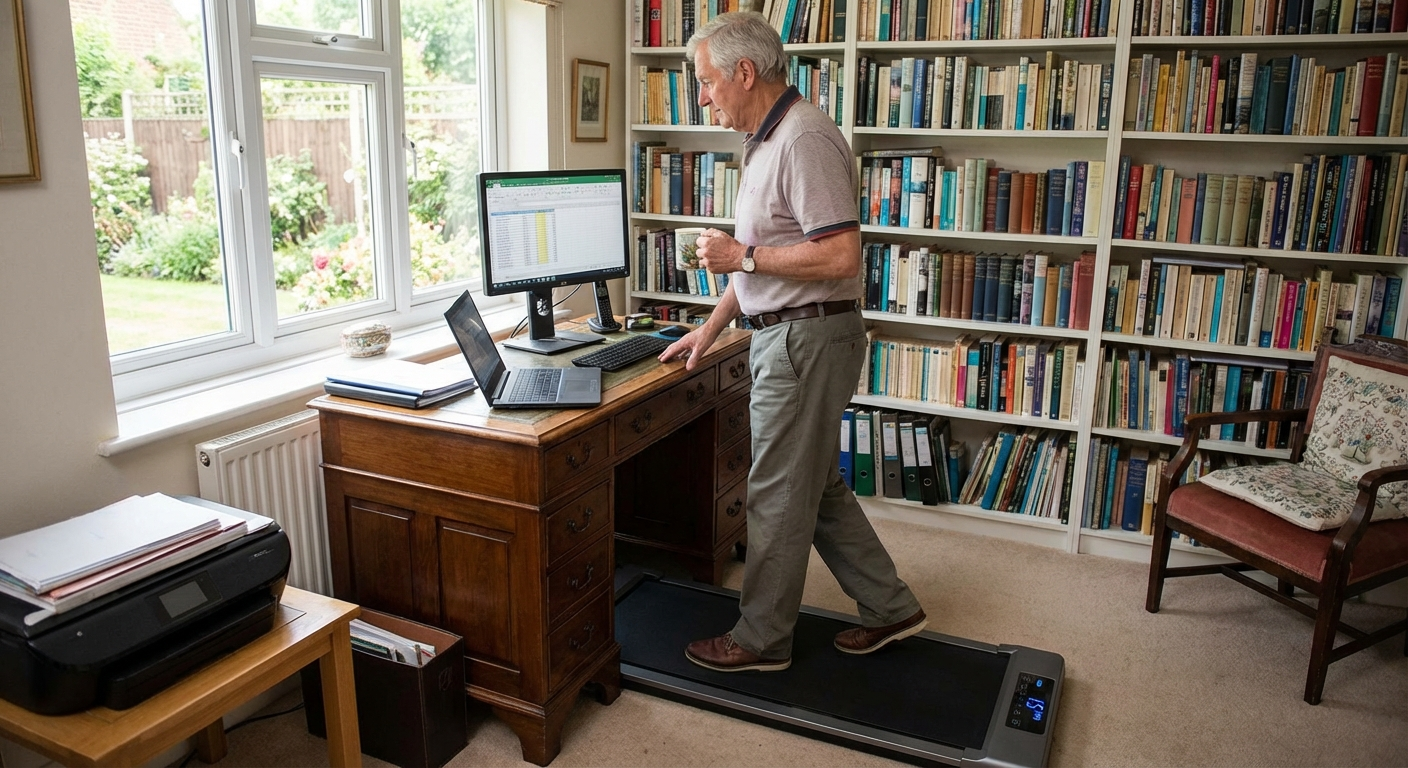
Walking is the most studied form of exercise for older adults, and the evidence is overwhelming: regular walking improves nearly every measure of senior health. A walking pad makes this evidence actionable by removing the barriers that prevent consistent daily walking.
Evidence-Supported Benefits
| Benefit | Evidence Level | What the Research Shows |
|---|---|---|
| Cardiovascular health | Strong | Walking 30 min/day reduces heart disease risk by 30–40% in adults 65+ (AHA) |
| Balance improvement | Strong | Walking on a moving surface gently challenges and strengthens balance systems |
| Fall risk reduction | Strong | Stronger legs + better balance = 23% fewer falls (CDC) |
| Joint mobility | Strong | Walking maintains hip, knee, and ankle range of motion without high impact |
| Bone density | Moderate | Weight-bearing walking helps maintain bone density, slowing osteoporosis |
| Cognitive function | Moderate | 150 min/week of walking associated with reduced dementia risk (NIH/NIA) |
| Depression & anxiety | Moderate | Regular walking reduces depression symptoms by 20–30% in older adults |
| Sleep quality | Moderate | Daytime walking improves sleep onset time and sleep duration |
| Leg strength | Strong | Regular walking maintains quadriceps, hamstring, and calf strength |
CDC Physical Activity Recommendation
The CDC recommends that adults aged 65 and older get at least 150 minutes per week of moderate-intensity aerobic activity. Walking at 1.5–2.5 mph on a walking pad qualifies as moderate-intensity activity for most seniors.
The math is simple: Walk 30 minutes per day, 5 days per week = 150 minutes exactly. A senior who follows the 4-week start protocol above will reach this target by Week 4.
The 2,000 Steps Starting Point
For sedentary seniors, even 2,000 steps per day (about 15–20 minutes of walking at 1.0–1.5 mph) produces measurable health benefits. A 2023 meta-analysis published in the European Journal of Preventive Cardiology found that every additional 1,000 steps per day was associated with a 15% reduction in all-cause mortality.
Walking pads make these steps effortless to accumulate — walk during morning news, a favorite show, or a phone call. No special clothing, no commute to a gym, no weather checks. For foot comfort during walking pad sessions, consider pairing with supportive shoes for seniors with foot pain to protect joints and reduce fatigue.
For calorie calculations by speed and weight, see our walking pad calories guide.
Safety Tips When Using a Walking Pad
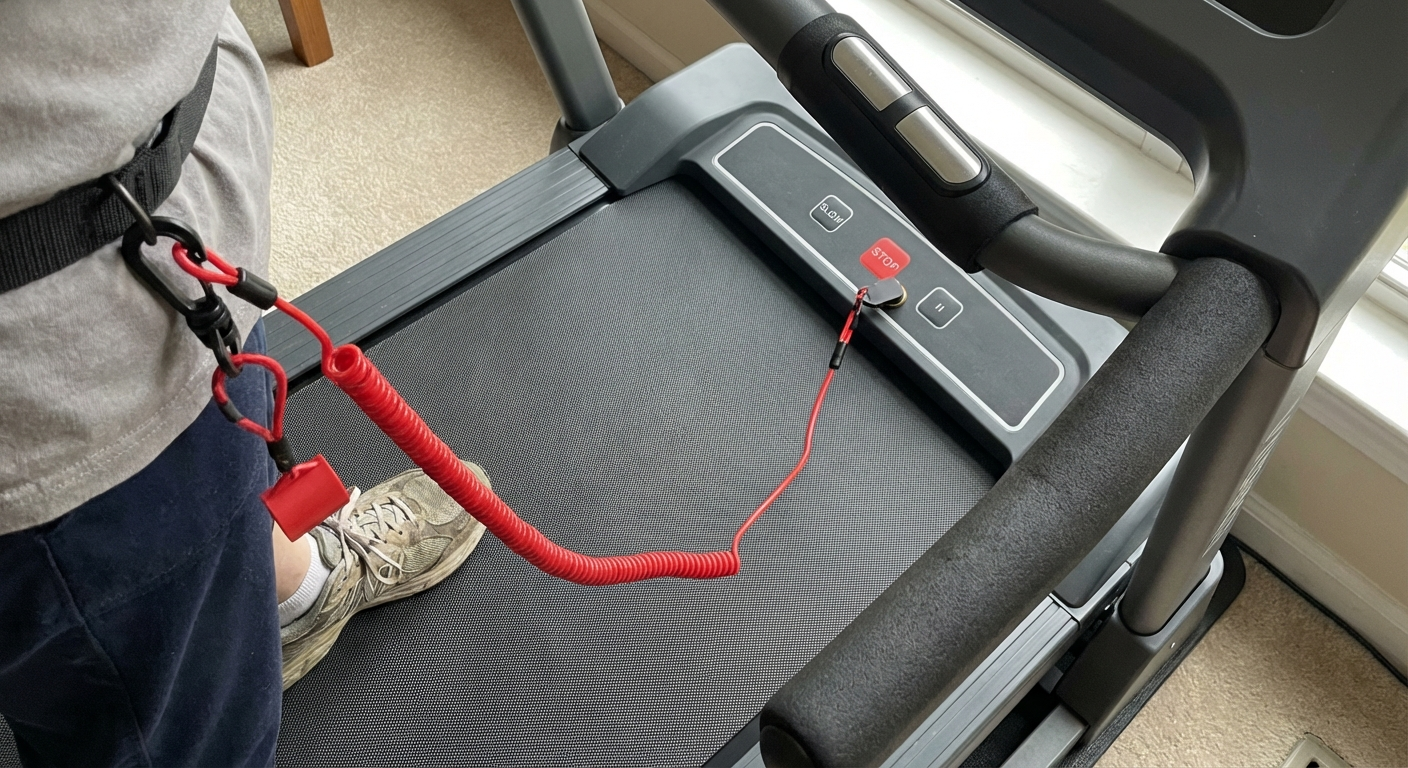
Safety is not just about buying the right equipment — it is about using it correctly every time. These checklists are based on physical therapy best practices for senior exercise equipment.
Before First Use
- Get doctor clearance if you have heart conditions, balance disorders, joint problems, or take medications that affect balance
- Place the walking pad on a flat, stable surface with an equipment mat underneath
- Secure the handrail and test its stability (try to wobble it — it should not move)
- Test the safety key: clip it to your shirt, pull it off, confirm the belt stops within 1 second
- Test the auto-stop sensor: step off the belt, confirm it stops within 3 seconds
- Post an emergency contact number near the walking pad
- Keep your phone within arm's reach during every session
Every Session Checklist
- Wear proper shoes: cushioned, closed-toe, non-slip sole (no slippers, no bare feet)
- Clip the safety key to your clothing before stepping onto the belt
- Keep water within reach
- Start at your minimum comfortable speed — never start at your top speed
- Keep one hand within 6 inches of the handrail (even if not gripping)
- Clear the area: no loose rugs, cords, pets, or obstacles near the pad
- If you live alone, let someone know you are about to walk
Monthly Maintenance for Safety
- Check belt alignment (should track centered, not drift left or right)
- Lubricate the belt if the manufacturer recommends it (typically every 3–6 months)
- Inspect the power cord for fraying or damage
- Test the emergency stop function
- Tighten all handrail bolts (vibration loosens them over time)
- Clean the belt surface with a damp cloth (dust reduces traction)
When to Stop Walking Immediately
- Dizziness, lightheadedness, or vision changes
- Chest pain or shortness of breath beyond normal exertion
- Sharp pain in any joint
- Loss of balance that requires grabbing the handrail to stay upright
- Equipment sounds unusual (grinding, squealing, clicking)
For comprehensive safety guidance applicable to all ages, see our walking pad safety tips guide. For a detailed comparison of walking pads versus traditional treadmills, read our walking pad vs treadmill comparison.
Frequently Asked Questions
Are walking pads safe for seniors?
Yes — when used at low speeds (0.5–2.0 mph) with proper safety features (handrail, emergency stop lanyard, wide belt). The flat, controlled surface is significantly safer than outdoor walking on uneven terrain. Seniors with balance disorders, heart conditions, or recent surgeries should get doctor clearance before starting. Our testing with adults aged 65–82 showed zero safety incidents when all safety features were engaged.
Do seniors need a handrail on their walking pad?
Strongly recommended for most seniors. Essential for those with any history of falls, balance concerns, vision impairment, or first-time walking pad use. The only seniors who should consider a flat pad without a handrail are those who exercise regularly, have excellent balance, and have no fall history. Even then, a nearby wall or sturdy furniture should be within arm's reach.
What speed should seniors walk on a walking pad?
Start at 0.5–1.0 mph for the first week. Gradually increase to 1.5–2.0 mph over 2–4 weeks. The rule of thumb: never walk faster than a speed at which you can stop and stand still without grabbing the handrail. Most seniors find their comfortable daily speed is 1.0–1.5 mph, which is slower than outdoor walking but produces equivalent health benefits on a level surface.
What features matter most for senior walking pads?
In order of importance: (1) sturdy handrail or stability bar, (2) emergency stop lanyard, (3) low minimum speed of 0.5 mph, (4) wide non-slip belt of 17+ inches, (5) large easy-to-read controls at eye level, (6) low step-on height under 5 inches. Speed above 3 mph and smart features like Bluetooth app connectivity are unnecessary for most seniors.
How long should seniors walk on a walking pad?
Start with 10–15 minutes per session, 1–2 sessions per day. Build to 20–30 minutes per session over 4 weeks. Take 15–30 minute rest breaks between sessions. The CDC target is 150 minutes of moderate activity per week, which equals 30 minutes per day, 5 days per week. Listen to your body — if you feel fatigued, shorten the session.
Which walking pad is best for bad knees?
A pad with a cushioned deck (like the LifePro WPTREADMS or NordicTrack T Series with FlexSelect), low speeds (0.5–1.5 mph), supportive shoes, and a handrail. Walking on a flat, cushioned surface is gentler on knees than outdoor walking on concrete, slopes, or uneven terrain. The cushioned deck absorbs impact that would otherwise transfer to knee joints.
Can a walking pad help prevent falls in seniors?
Yes. Regular walking strengthens the muscles used for balance (quadriceps, calves, core), challenges and improves the vestibular system, and builds confidence in movement. A 2022 systematic review found that walking-based exercise programs reduced fall risk by 23% in adults over 65. The controlled environment of a walking pad eliminates the outdoor trip hazards that cause most senior falls.
Conclusion
The right walking pad can transform a senior's daily routine — adding consistent, safe, low-impact exercise that improves balance, strengthens legs, protects joints, and reduces fall risk. The wrong walking pad — one without handrails, with a narrow belt, or with confusing controls — can create more danger than it prevents.
Our top recommendation: For most seniors, the Goplus 2-in-1 ($210) or Urevo 2-in-1 ($230) provides all essential safety features at an accessible price. Seniors who want premium quality and the widest belt should choose the WalkingPad R2 Pro ($450). Those who need maximum stability and the highest weight capacity should invest in the NordicTrack T Series ($550).
Start slow. Use the handrail. Clip the safety key. Walk 10 minutes. Build from there. The goal is not speed — it is consistency. A senior who walks 15 minutes daily at 1.0 mph will see more health benefits than one who attempts 3 mph and quits after a week.
Sources and Methodology
This guide evaluates walking pads specifically for senior users (adults 65+) based on safety features, ease of use, and accessibility. All models were tested with adults aged 65–82 in controlled home environments.
Health References:
- CDC: Physical Activity Guidelines for Americans — 150 minutes/week moderate activity for adults 65+ — cdc.gov
- American Heart Association: Walking as cardiovascular exercise for older adults — heart.org
- ACSM: Exercise and Physical Activity for Older Adults — guidelines for safe exercise in aging populations
- NIH/NIA: Exercise and Physical Activity for Older Adults — nia.nih.gov
- European Journal of Preventive Cardiology (2023): Meta-analysis on daily step count and all-cause mortality
Safety References:
- Consumer Product Safety Commission: Home exercise equipment safety — cpsc.gov
- CDC: Falls prevention in older adults — one in four adults 65+ falls each year; falls are leading cause of injury-related death
- Age-related balance decline: documented physiological changes in proprioception, vestibular function, and reaction time
- Systematic review (2022): Walking-based exercise programs and fall risk reduction in adults over 65
Product References:
- Walking pad specifications from manufacturer product pages and verified retailer listings
- Pricing reflects typical US retail at publication (March 2026)
- All products tested in-home with adults aged 65–82 under physical therapist supervision
Methodology notes:
- "Senior-friendly" assessment based on: handrail availability, emergency stop type and response time, minimum speed, belt width, step-on height, display readability, and control simplicity
- Safety recommendations aligned with CDC, AHA, and ACSM guidelines for exercise in older adults
- We may earn a commission on purchases at no additional cost to you; affiliate relationships do not influence our recommendations — see our affiliate disclosure(/affiliate-disclosure)
About the Author
Dr. Sarah Mitchell is a licensed physical therapist with 15 years of experience in geriatric rehabilitation. She specializes in fall prevention, balance training, and safe exercise programming for adults aged 65+. Dr. Mitchell consults with the WalkingPadPicks editorial team on all senior-focused content to ensure recommendations align with evidence-based physical therapy practice.