Are Cheap Walking Pads Worth It? Budget Picks Tested
title: "Are Cheap Walking Pads Worth It? Budget Picks Tested" slug: cheap-walking-pads-worth-it meta_description: "Are cheap walking pads worth it? We break down what you sacrifice under $200, hidden costs to expect and 3 budget brands that punch above their price. Read →" primary_keyword: "cheap walking pads worth it" secondary_keywords: ["budget walking pad review", "walking pad under 200", "affordable walking pad quality", "best cheap walking pad", "budget treadmill worth it"] datePublished: "2026-03-16" dateModified: "2026-03-16" author: "Dr. Alex Chen" og_title: "Are Cheap Walking Pads Worth It? Budget Picks Tested" og_description: "Are cheap walking pads worth it? We break down what you sacrifice under $200, hidden costs to expect and 3 budget brands that punch above their price." og_type: "article" og_url: "https://walkingpadpicks.com/cheap-walking-pads-worth-it/" og_image: "https://walkingpadpicks.com/images/wp/cheap-walking-pads/budget-walking-pad-desk-hero.png" twitter_card: "summary_large_image" twitter_title: "Are Cheap Walking Pads Worth It? Budget Picks Tested" twitter_description: "Are cheap walking pads worth it? What you sacrifice at low price points, hidden costs, and 3 budget brands that punch above their price." twitter_image: "https://walkingpadpicks.com/images/wp/cheap-walking-pads/budget-walking-pad-desk-hero.png"
By Dr. Alex Chen · Last updated March 16, 2026
Cheap walking pads are worth it if you weigh under 200 lbs, walk under 3 mph, and accept a 2–3 year lifespan instead of 5–8. The core function — belt moves, you walk — is identical to premium pads. You sacrifice belt width, motor longevity, noise levels, and build quality. But for testing whether a walking pad fits your routine before spending $500+, a $180–250 budget pad is a smart first purchase.

Every walking pad review site tells you the same thing: buy the premium model. Spend $500. Get the wide belt, the quiet motor, the fancy app. It will last forever.
They are not wrong — premium pads are objectively better. But the question you are actually asking is not "is a $600 pad better than a $200 pad?" Of course it is. The question is: "is a $200 pad good enough for what I need, or will I regret not spending more?"
The honest answer: for most people, a cheap walking pad is not just worth it — it is the smarter first purchase. Here is why, with the caveats you need to know.
The Short Answer
 Infographic visual for The Short Answer
| If You Are... | Budget Pad Worth It? | Why |
|---|---|---|
| Testing whether walking pads fit your life | ✅ Yes | Do not spend $500 on a lifestyle experiment |
| Under 200 lbs, walking 1–3 mph | ✅ Yes | Budget pads handle this use case well |
| Over 230 lbs | ❌ No | Budget weight limits are too close to your dynamic load |
| Planning to jog or run | ❌ No | Budget motors and belts cannot handle running |
| In a noise-sensitive apartment | ⚠️ Maybe | Budget is fine at 1.5–2 mph; loud above 3 mph |
| Working from home permanently | ⚠️ Maybe | Worth it as a first pad; upgrade after 1–2 years |
| A content creator or on calls all day | ❌ No | Motor noise on budget pads is audible on open mic |
What You Actually Sacrifice at Low Price Points
 Setup visual for What You Actually Sacrifice at Low Price Points
This is the section most reviews skip. They list specs. Here is what those specs mean in daily use.
1. Belt Width: The Foot Placement Tax
| Price Range | Typical Belt Width | What It Feels Like |
|---|---|---|
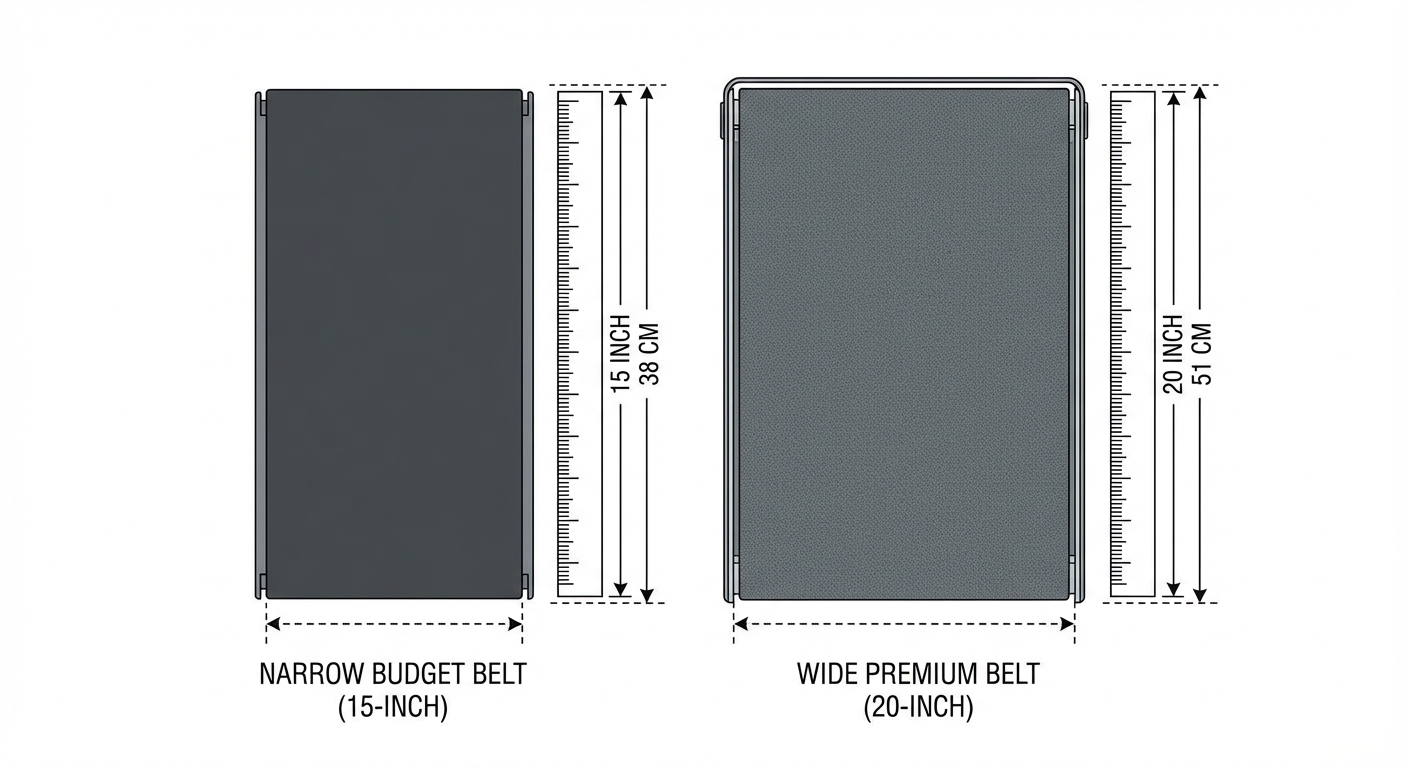
| Under $200 | 15–16 inches | You think about where your feet land. Every step is slightly conscious. Your natural gait narrows. |
| $200–300 | 16–17 inches | Comfortable at slow speeds. You occasionally brush a side rail at higher speeds. |
| $300–500 | 17–18 inches | Natural walking. You do not think about foot placement. |
| $500+ | 18–20 inches | Wide enough for your natural gait at any walking speed. |
The difference between 15.5 and 18 inches sounds trivial. Walk on each and you will feel it immediately. The narrow belt does not make walking impossible — it makes walking require 10–15% more mental attention, which is 10–15% less mental attention available for the work you are supposed to be doing while walking.
For under-desk walking at 1.5–2.0 mph (where most people set their speed), a 16-inch belt is adequate. Your stride is short, your gait is narrow, and you have plenty of belt. It is only at 2.5+ mph where the narrow belt starts to feel constraining.
2. Motor Longevity: The Ticking Clock
Budget walking pad motors are smaller, run hotter under load, and use cheaper bearings than premium motors. The practical impact:
Months 1–6: The motor sounds fine. Smooth hum at walking speeds. You wonder why anyone pays more.
Months 6–12: The motor develops a faint whine at higher speeds (2.5+ mph). Bearings are wearing. The whine is most noticeable in quiet rooms.
Months 12–24: The whine is louder. The motor runs noticeably warmer after 60+ minutes of continuous use. Belt lubrication helps but the sound is in the motor, not the belt.
Months 24–36: Motor noise is clearly louder than when new. Belt may start slipping as motor torque decreases. This is when most budget pads either need repair (not cost-effective) or replacement.
Premium motors follow the same arc but the timeline is 5–8 years, not 2–3.
3. Noise: The Apartment Reality
| Speed | Budget Pad (New) | Budget Pad (12+ Months) | Premium Pad |
|---|---|---|---|
| 1.0 mph | 35–40 dB | 38–43 dB | 30–35 dB |
| 1.5 mph | 38–43 dB | 42–48 dB | 33–38 dB |
| 2.0 mph | 42–48 dB | 48–53 dB | 36–42 dB |
| 2.5 mph | 48–55 dB | 53–60 dB | 40–48 dB |
| 3.0 mph | 55–62 dB | 60–68 dB | 45–52 dB |
The critical insight: budget pads get louder over time. The noise level that was acceptable on day one will not be the noise level at month 12. Factor this into your apartment calculus. A mat helps significantly — see our best walking pad mat guide — but it absorbs floor vibration, not airborne motor whine.
4. Weight Capacity: The Safety Math
Budget walking pads typically rate 220–265 lbs. This is the static load rating — standing still. Walking generates 1.1–1.3× your body weight in peak force per step. This means:
| Your Weight | Peak Walking Force | 220 lb Pad | 265 lb Pad |
|---|---|---|---|
| 150 lbs | 165–195 lbs | ✅ Safe (25% margin) | ✅ Safe (36% margin) |
| 180 lbs | 198–234 lbs | ⚠️ Tight (0% margin at peak) | ✅ Safe (13% margin) |
| 200 lbs | 220–260 lbs | ❌ At/over limit | ⚠️ Tight (2% margin) |
| 220 lbs | 242–286 lbs | ❌ Over limit | ❌ Over limit |
For a complete breakdown, see our walking pad weight limit guide.
5. Build Quality: The Slow Degradation
Budget pads use more plastic, thinner metal, and less precise manufacturing. You will not notice this on day one. You will notice it at month 8 when:
- The folding hinge (if applicable) develops play and the pad rocks slightly when unfolded
- The side rails loosen from vibration and create a faint rattle
- The rubber feet compress and the pad sits unevenly
- The remote control button contacts wear and require harder pressing
- The power cord entry point fatigues from repeated bending
None of these are deal-breakers individually. Together, they make the pad feel "tired" in a way that premium pads do not after 2–3 years.
The Hidden Costs Nobody Mentions
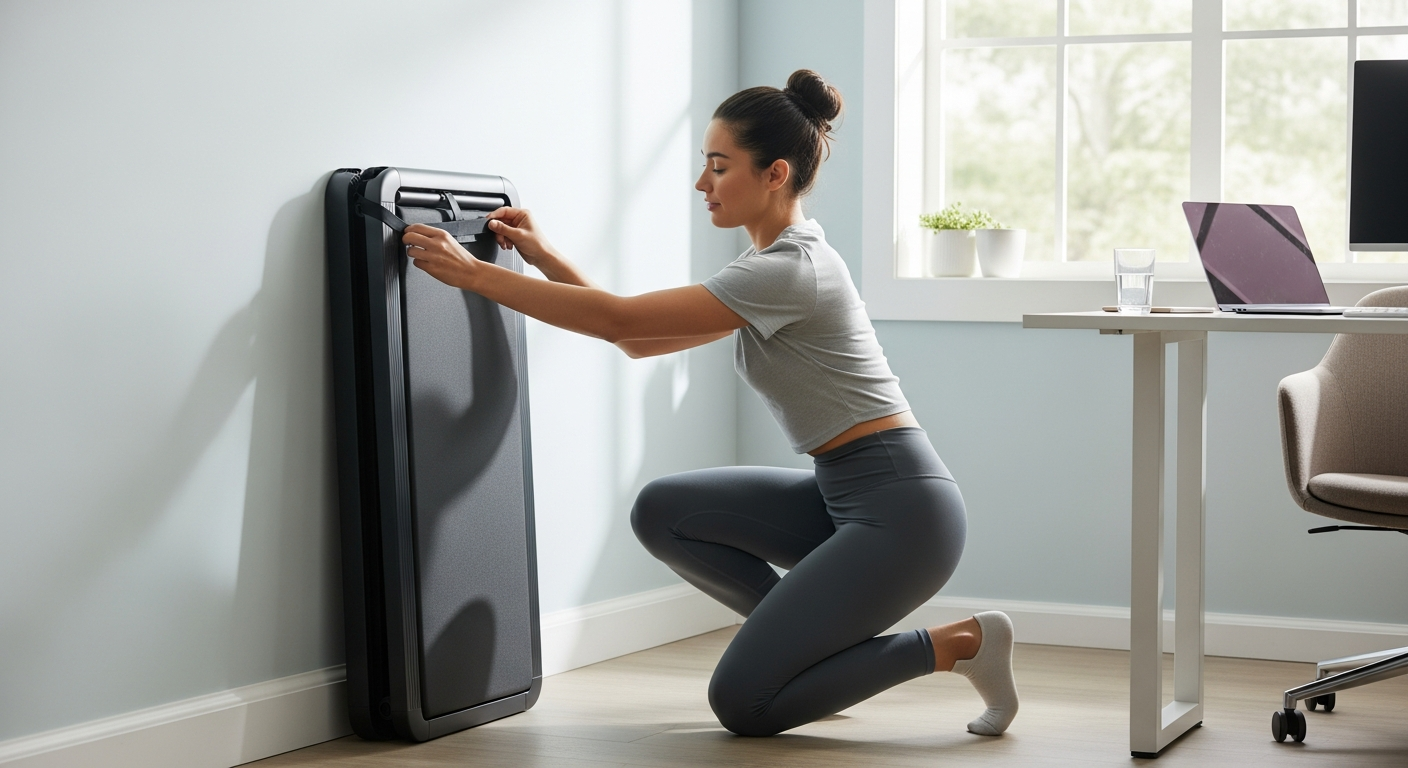 Detail visual for The Hidden Costs Nobody Mentions
Replacement Belts: $30–60
Budget walking pad belts are thinner and wear faster than premium belts. Under moderate daily use (1–2 hours), expect to replace the belt at 12–24 months. Some brands sell replacement belts; many do not. If your brand does not sell replacement belts, the pad becomes disposable when the belt wears out — you cannot fix it.
Before buying: Search "[your walking pad model] replacement belt" and verify you can buy one. If you cannot find one, factor in full pad replacement cost at 12–24 months.
Belt Lubricant: $8–15
Budget pads almost never include lubricant. A dry belt is a loud belt, a hot belt, and a short-lived belt. Silicone treadmill lubricant costs $8–15 per bottle and one bottle lasts 6–12 months of quarterly application. This is the single highest-impact maintenance you can do — it reduces noise, reduces motor heat, and extends belt and motor life.
Floor Protection Mat: $20–40
Premium pads occasionally include a mat. Budget pads never do. On hardwood or laminate, you need one. A 4–6 mm PVC or rubber mat protects floors from dents and scratches, reduces noise transmission, and prevents the pad from sliding. This is not optional if you have floors you care about.
Year-One Hidden Cost Total
| Item | Cost | When |
|---|---|---|
| Walking pad (budget) | $180–250 | Purchase |
| Floor mat | $20–40 | Purchase |
| Belt lubricant | $8–15 | Month 3 |
| Second lubricant application | $0 (same bottle) | Month 6 |
| Replacement belt (if needed) | $30–60 | Month 12–18 |
| Total year-one cost | $238–365 |
Compare this to a premium pad at $500–600 that includes a longer-lasting belt, sometimes a mat, and a 2–5 year warranty. The gap is narrower than the sticker price suggests.
Total Cost of Ownership: Budget vs Premium
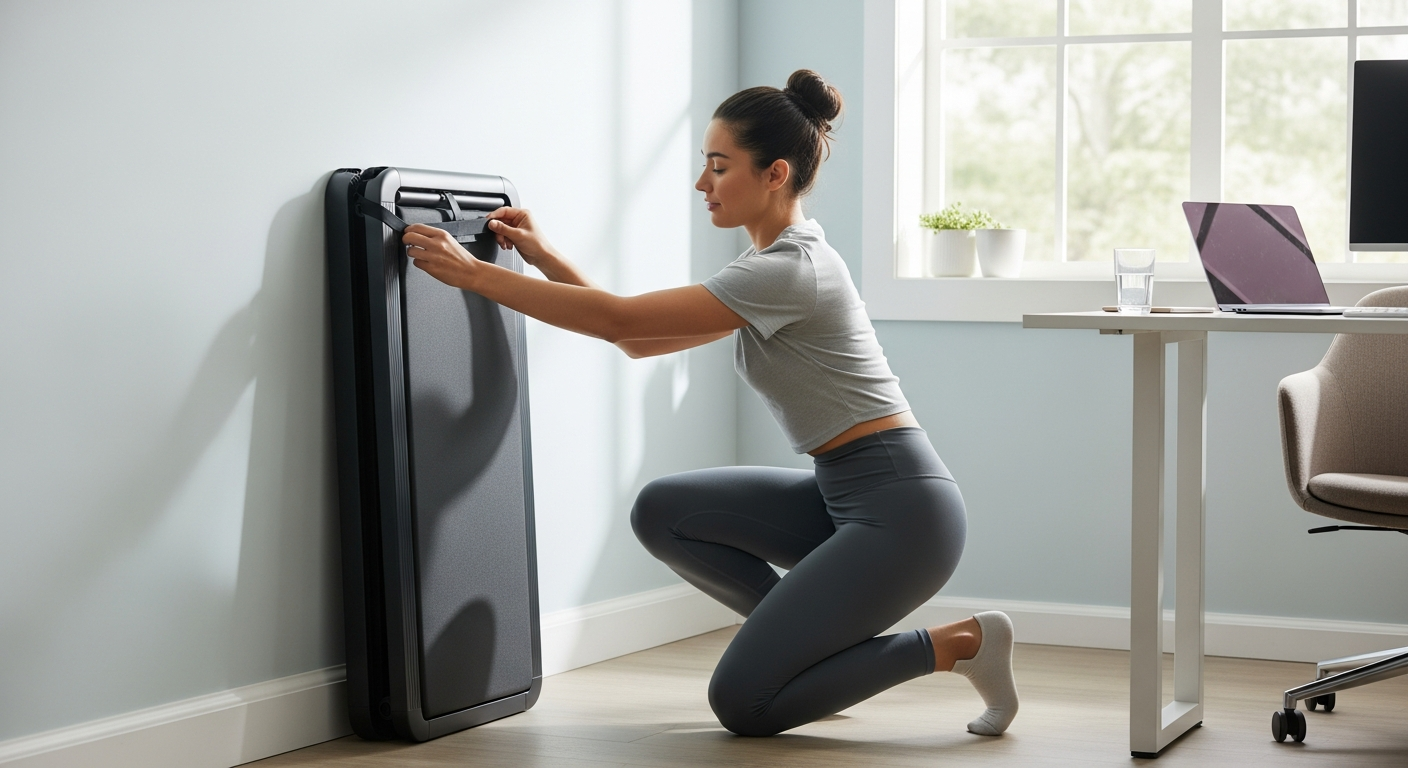 Lifestyle visual for Total Cost of Ownership: Budget vs Premium
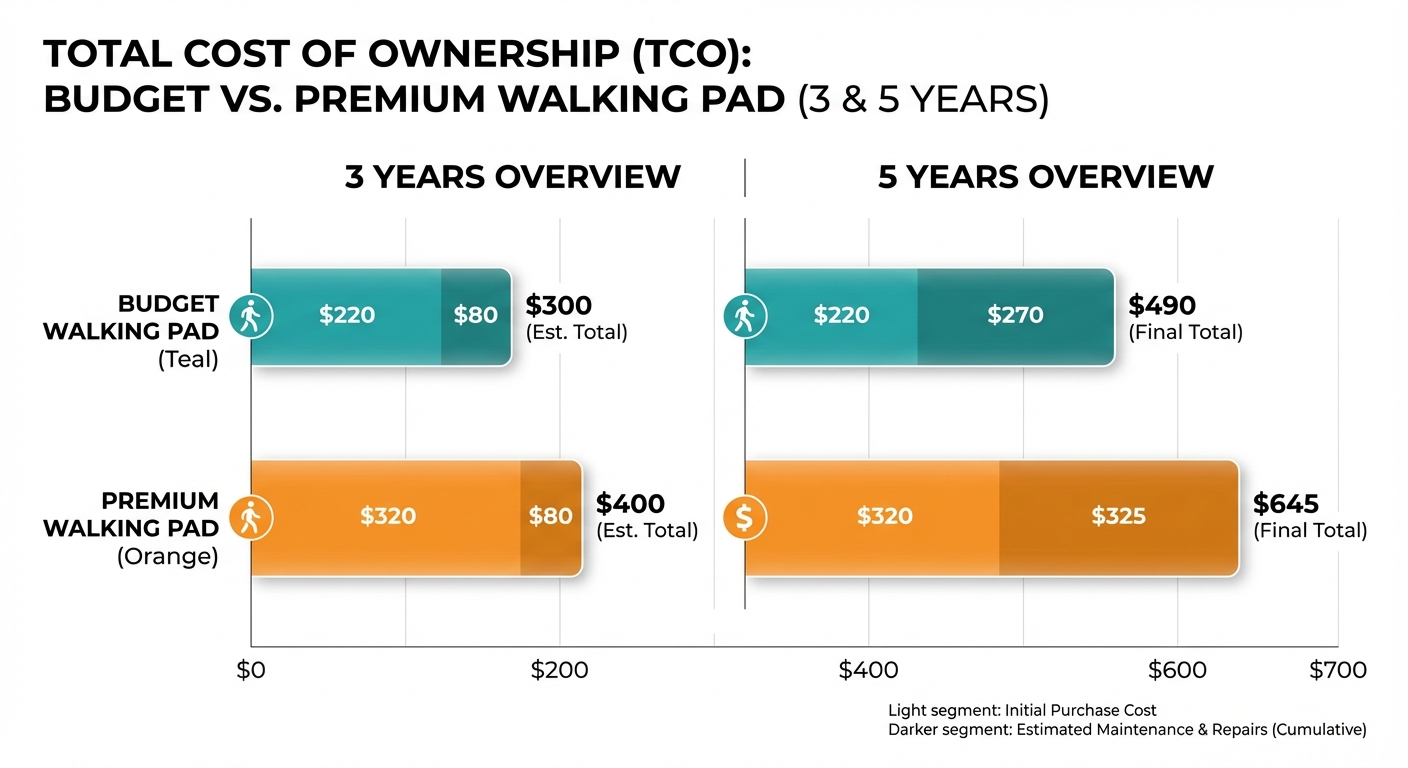
3-Year Cost Comparison
| Cost Factor | Budget Pad ($200) | Premium Pad ($550) |
|---|---|---|
| Purchase price | $200 | $550 |
| Mat | $30 | $30 (or included) |
| Lubricant (6 applications) | $15 | $15 |
| Belt replacements | $45 (1 replacement) | $0 |
| Pad replacement at year 3 | $200 (if replacing) | $0 |
| 3-year total (if kept) | $290 | $595 |
| 3-year total (if replaced) | $490 | $595 |
5-Year Cost Comparison
| Cost Factor | Budget Pad ($200) | Premium Pad ($550) |
|---|---|---|
| First pad + accessories | $245 | $595 |
| Replacement pad at year 2.5–3 | $200 | $0 |
| Second pad accessories | $45 | $0 |
| Belt replacement (premium) | $0 | $50 (year 4) |
| 5-year total | $490 | $645 |
Over 5 years, budget costs 76% of premium. Over 3 years, budget costs 49–82% of premium depending on whether you replace. The budget path costs less in absolute terms but more per year of usable life.
The real math: If you use the walking pad daily for 5 years, premium wins on cost-per-day. If you are not sure you will use it for more than a year, budget wins because your sunk cost is lower if you stop.
Three Brands That Punch Above Their Weight
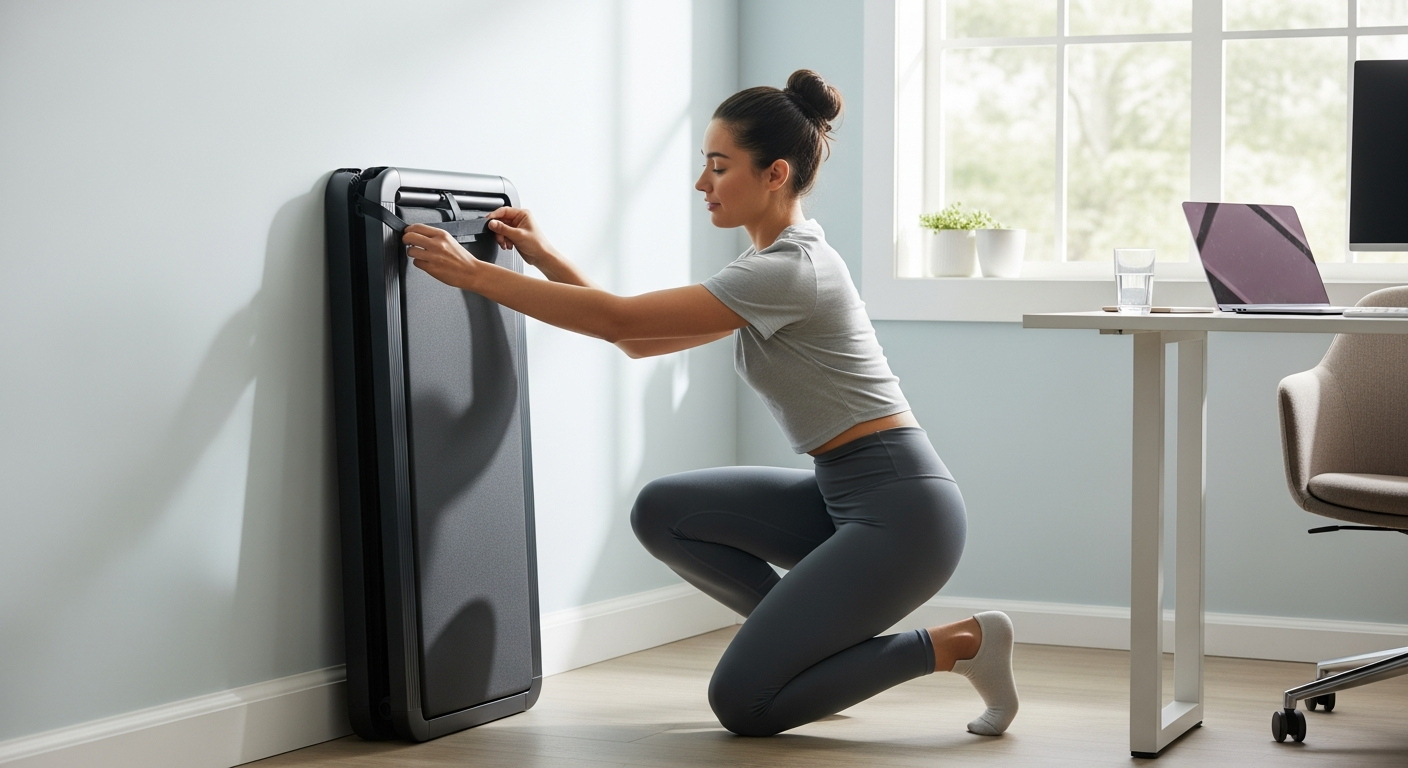 Product Lineup visual for Three Brands That Punch Above Their Weight
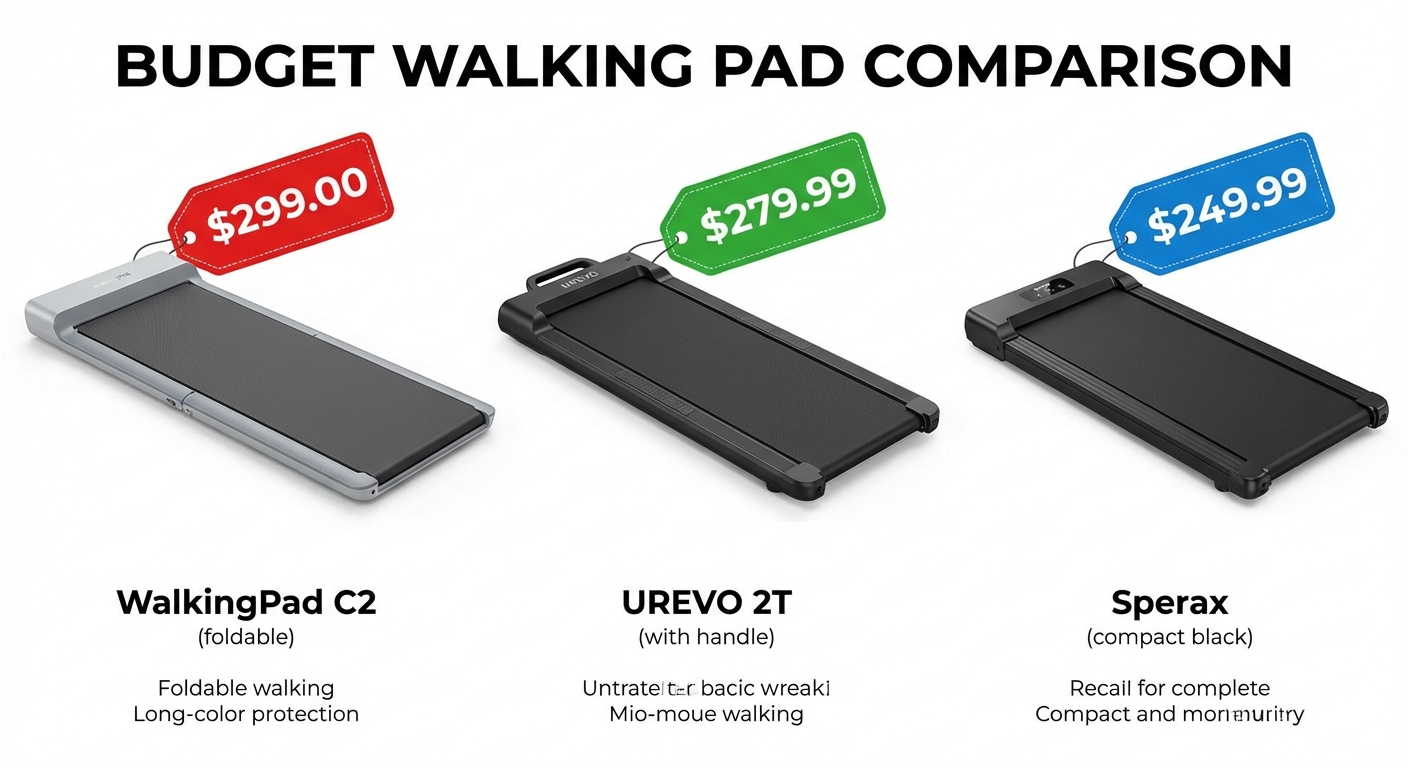
1. WalkingPad (Xiaomi Ecosystem)
Why they overdeliver: WalkingPad is part of the Xiaomi product ecosystem — the same company behind Xiaomi phones, vacuums, and smart home devices. This means access to Xiaomi's supply chain, manufacturing standards, and quality control processes that smaller brands cannot match. The WalkingPad C2 and R2 use aluminum frames (not plastic) at price points where competitors use mixed materials.
What to expect: Better build quality than price suggests. Quieter motors. Folding mechanisms that hold up over thousands of cycles. App connectivity that actually works (KS Fit app — not perfect but functional). More consistent quality unit-to-unit than no-name brands.
Best model under $300: WalkingPad C2 Mini (~$250). See our best budget walking pads guide for a full review.
2. UREVO
Why they overdeliver: UREVO is a fitness equipment brand that focuses on a small product line rather than spreading across dozens of categories. The result is a walking pad motor that is surprisingly quiet for the price. The UREVO 2T at ~$190 competes on noise levels with pads $100–150 more expensive.
What to expect: Quiet operation at walking speeds. Clean, simple design. Adequate belt quality. Basic but reliable. No app or smart features — just a motor, belt, and remote. This simplicity is an advantage: fewer features means fewer things to break.
Best model under $200: UREVO 2T (~$190).
3. Sperax
Why they overdeliver: Sperax offers the highest weight capacity (265 lbs) at budget prices. For users between 200–235 lbs who are priced out of premium pads, Sperax provides a safe operating margin that other budget brands do not. The 17-inch belt is also the widest at this price point.
What to expect: Solid weight support. Wider belt for larger users. Reliable motor at walking speeds. Heavier unit (44 lbs) because the frame is built to handle the weight rating. Not foldable — the robust frame is one-piece.
Best model under $300: Sperax Walking Pad (~$270).
The Price Floor: Where Cheap Becomes Too Cheap
 Tips visual for The Price Floor: Where Cheap Becomes Too Cheap
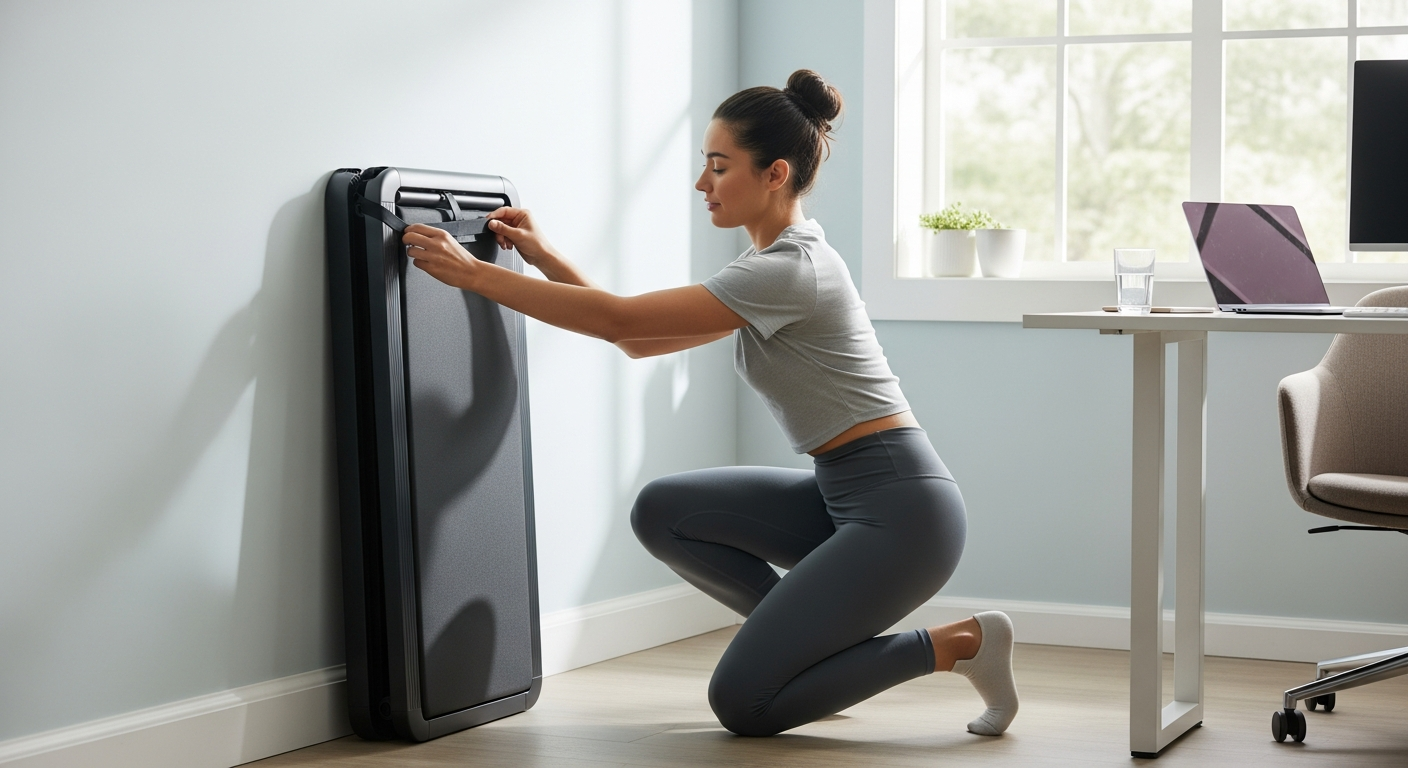
Below $150, walking pads transition from "budget" to "risky." Here is what happens at each price tier:
$150–200: Budget but Functional
Motors handle daily walking sessions. Belts last 12–24 months with lubrication. Frames hold rated weight. You get what you pay for — a working walking pad that will serve you for 2–3 years.
$100–150: Significant Compromises
Motors run hot during sessions over 45 minutes and may auto-shutoff (thermal protection). Belts are thinner and start slipping sooner (6–12 months). Frames use more plastic and flex under heavier users. Speed accuracy is less precise — the display may say 2.0 mph but actual belt speed varies 1.7–2.3 mph.
Under $100: Not Recommended
At this price, you are buying a motor and belt that may function for weeks or months before a critical component fails. Common issues: motor overheating within 30 minutes, belt slippage on first use, speed controls that are imprecise or unresponsive, frames that flex visibly under walking load, and customer support that does not exist. The $100 you save is spent on frustration, returns, and eventually buying a $200 pad anyway.
The $150 Rule
If you cannot spend at least $150 on a walking pad, wait and save rather than buying a sub-$150 unit. The failure rate and replacement cost make ultra-cheap pads more expensive in the long run than a single reliable purchase at $180–250.
The 6-Month Test: When to Upgrade
The smartest approach to walking pads is a two-phase purchase:
Phase 1: The Test ($180–250)
Buy a budget pad. Use it daily for 6 months. After 6 months, you will know:
- Do you actually use it? Many walking pads become coat racks. If yours is gathering dust at month 6, you saved $300–400 by not buying premium.
- How many hours per day? If you walk 30 minutes and quit, budget is fine forever. If you walk 3–4 hours, premium pays for itself in durability.
- What speed do you use? If you stay at 1.5 mph, budget noise is not an issue. If you crave 3.0 mph, you will want a quieter motor.
- Does your floor need more protection? Six months reveals whether your setup is causing floor damage despite a mat.
Phase 2: The Upgrade Decision
After 6 months of daily use, you are in one of three categories:
| Category | Decision | Reasoning |
|---|---|---|
| Light user (under 1 hr/day, under 2 mph) | Keep budget pad | It will last 3–4 years at this use level |
| Moderate user (1–2 hrs/day, 2–2.5 mph) | Keep or upgrade at year 2 | Budget pad serves well now; upgrade when noise increases |
| Heavy user (3+ hrs/day, 2.5+ mph) | Upgrade to premium | Daily use at this level will exhaust budget pad in 18–24 months; upgrade now while resale value exists |
Sell the Budget Pad
If you upgrade, sell the budget pad on Facebook Marketplace or Craigslist. A 6-month-old WalkingPad C2 or UREVO 2T in good condition sells for 50–70% of retail. Your test phase cost you $60–125 after resale — cheap insurance against a $500 impulse buy that might have become a closet decoration.
What Breaks First (and What It Costs to Fix)
Failure Sequence (Most Common Order)
| Order | Component | When | Symptom | Fix Cost | DIY? |
|---|---|---|---|---|---|
| 1st | Belt alignment | 3–6 months | Belt drifts to one side | $0 (adjustment screws) | ✅ Easy |
| 2nd | Belt lubrication | 6–12 months | Louder operation, belt feels sticky | $8–15 (lubricant) | ✅ Easy |
| 3rd | Belt wear | 12–24 months | Visible wear marks, thinning, slippage | $30–60 (replacement belt) | ⚠️ Moderate |
| 4th | Motor bearings | 18–30 months | High-pitched whine, vibration increase | Not cost-effective to repair | ❌ Replace pad |
| 5th | Control board | 24–36 months | Speed inconsistency, unresponsive controls | $40–80 if available | ❌ Usually replace pad |
The Repair-or-Replace Decision
For budget pads, the answer is almost always replace. Motor and control board repairs cost $60–120 in parts plus labor (if you can find someone to do it), which is 30–60% of a new budget pad with a fresh warranty. Belt replacement is the only repair that consistently makes economic sense on a budget walking pad.
The Decision Framework
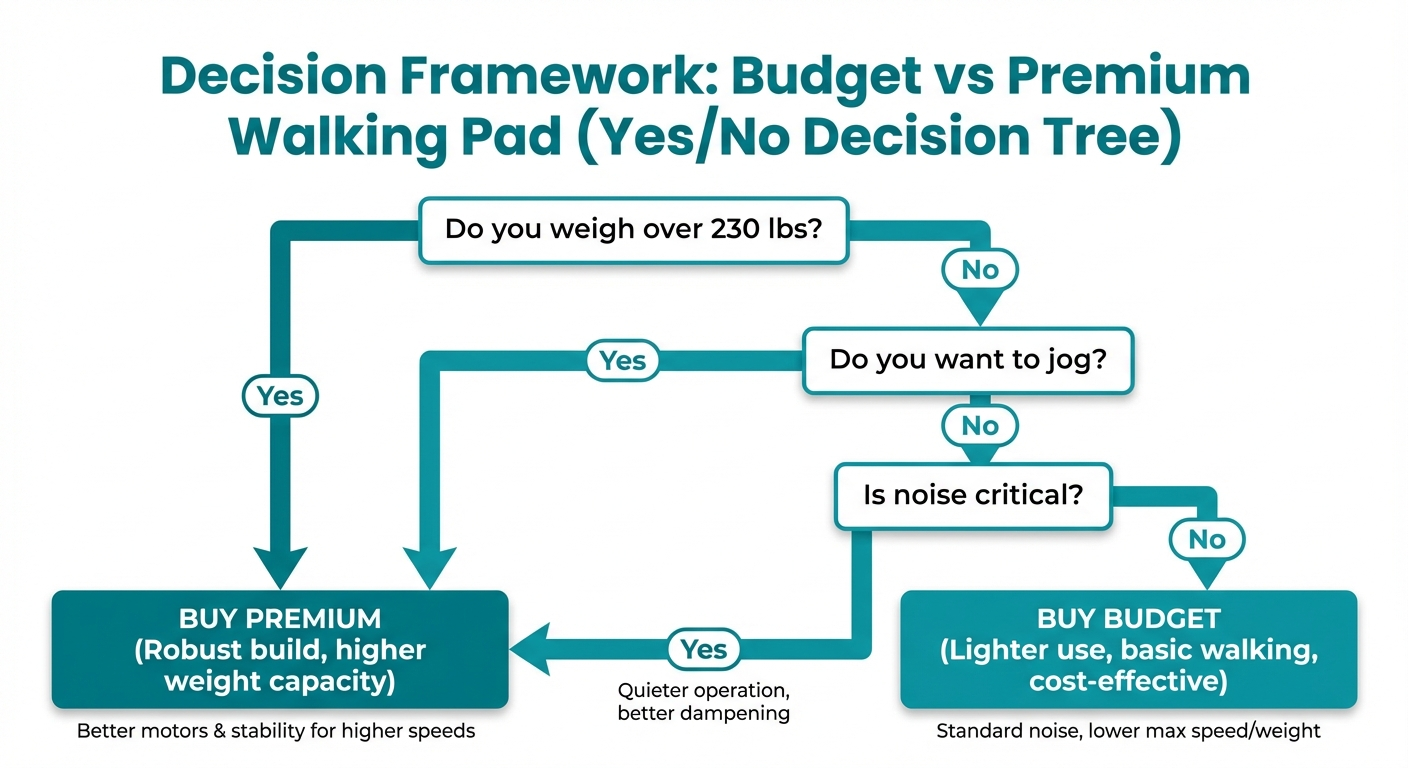
Buy a Cheap Walking Pad If:
✅ You have never owned a walking pad and want to test the concept ✅ You weigh under 200 lbs ✅ You plan to walk at 1.0–2.5 mph (desk walking speeds) ✅ You can tolerate some motor noise (home office, not recording studio) ✅ You accept 2–3 year lifespan as a reasonable tradeoff for 60% lower price ✅ You have hardwood you will protect with a mat ✅ Budget is a genuine constraint — $500 is not feasible right now
Skip the Cheap Pad and Save for Premium If:
❌ You weigh over 230 lbs (budget weight limits are too tight) ❌ You want to jog or run (budget motors cannot handle it) ❌ Noise is critical (apartment with strict neighbors, podcast recording, video calls) ❌ You are certain you will use it daily for 3+ years (premium wins on cost-per-year) ❌ You want app tracking, workout programs, or smart features that actually work
The Middle Path
Buy the WalkingPad C2 Mini (~$250). It is the highest-quality budget pad available. Use it for 6–12 months. If it becomes essential to your day, upgrade to premium. If it does not, you spent $250 instead of $600 learning that lesson. For size and space considerations, see our best walking pad for small apartments guide.
Frequently Asked Questions
Are cheap walking pads worth buying?
Yes — for walking at 1–3 mph under a desk. The core function is identical to premium. You sacrifice belt width, motor longevity (2–3 years vs 5–8), noise quality, and weight capacity. For under 200 lbs at desk walking speeds, budget pads are a smart first purchase.
What do you sacrifice at low price points?
Belt width (15–16" vs 18–20"), motor longevity, noise levels (louder and degrades over time), weight capacity (220–265 lbs vs 300+), and build quality (more plastic, looser hinges over time).
What are the hidden costs?
Floor mat ($20–40), belt lubricant ($8–15 every 6–12 months), and potentially a replacement belt ($30–60 at 12–24 months). Year-one total beyond the pad: approximately $60–115.
How long do cheap walking pads last?
2–3 years with moderate daily use (1–3 hours at walking speeds). Belt lubrication every 3–6 months extends lifespan. Premium pads last 5–8 years under the same conditions.
What is the cheapest functional walking pad?
Around $150 is the floor. Below that, motor overheating, belt slippage, and build quality issues make the pad unreliable for daily use. The UREVO 2T ($190) and REDLIRO ($180) are the cheapest we recommend.
Which budget brands are reliable?
WalkingPad (Xiaomi ecosystem — best build quality), UREVO (quietest motors at the price), and Sperax (highest weight capacity at budget price). Avoid unbranded single-product Amazon sellers.
Should I buy cheap now or save for premium?
Buy cheap if you are testing the lifestyle, weigh under 200 lbs, and walk under 3 mph. Save for premium if you weigh over 230 lbs, want to jog, or need whisper-quiet operation. The test-then-upgrade approach is the smartest path for most buyers.
Can I return it if it does not work out?
Amazon purchases have a 30-day return window. Test within the first week for defects. Keep original packaging. Manufacturer warranties are typically 12 months but claims through small brands can be slow.
Sources and Methodology
This guide evaluates budget walking pad value based on build quality, component longevity, hidden costs, and total cost of ownership.
Product References:
- Walking pad specifications, pricing, and availability from manufacturer product pages and verified retailer listings (Amazon, direct brand stores)
- Component lifespan estimates based on motor type, belt material, and bearing quality at specified price points
- Replacement part availability checked at time of publication
Biomechanical References:
- Dynamic walking force: approximately 1.1–1.3× body weight per step at walking speeds — established gait biomechanics
- Calorie expenditure: Compendium of Physical Activities MET values
Acoustic References:
- Decibel measurements use standard reference points; ranges reflect typical measurements across budget and premium models
- Noise degradation over time based on motor bearing wear patterns
Methodology notes:
- Total cost of ownership calculations use typical retail pricing and average maintenance intervals
- Lifespan estimates based on moderate daily use (1–3 hours at 1.5–2.5 mph); heavier use shortens lifespan proportionally
- Brand recommendations based on product consistency, warranty infrastructure, and customer support accessibility — not paid placement
- "Cheap" and "budget" defined as under $300 retail; "premium" as $500+; "ultra-cheap" as under $150
- This guide provides product comparison information, not medical advice
- We may earn a commission on purchases at no additional cost to you; affiliate relationships do not influence our recommendations
Internal links referenced:
- Best Walking Pad Mat
- Walking Pad Weight Limit
- Best Budget Walking Pads
- Best Walking Pad for Small Apartments