Walking Pad vs Treadmill for Weight Loss (2026)
Every walking pad buyer asks this question: should I just buy a real treadmill instead? A treadmill runs faster, inclines steeper, and burns more calories per minute. On paper, the treadmill wins for weight loss. In practice, it often loses — because it sits unused in a spare bedroom while the walking pad gets 3 hours of daily use under a desk.
This guide compares walking pads and treadmills specifically through the weight loss lens: calorie burn, intensity options, and — most importantly — real-world adherence. The device you actually use beats the device that is theoretically superior.
The Core Tradeoff: Intensity vs Consistency
Treadmill: High Intensity, Limited Time
A treadmill can run at 12 mph and incline to 15%. It enables running, jogging, hill walking, and HIIT — the highest calorie-burning activities available on home equipment. But using a treadmill requires dedicated exercise time. You cannot run at 8 mph while answering emails. A typical treadmill session is 20–45 minutes of focused effort.
Walking Pad: Low Intensity, Unlimited Time
A walking pad maxes out at 3.5–4.0 mph on a flat surface. It does not support running, incline, or HIIT. What it does support is walking for hours while you work. You burn fewer calories per minute but accumulate more total minutes — because the minutes are free. They come from your work hours, not your leisure time.
The Math That Matters
| Scenario | Calories Burned | Time Investment | Times Per Week | Weekly Burn |
|---|---|---|---|---|
| Treadmill: 30 min at 6 mph | ~300 net | 30 min (dedicated) | 3–4× | 900–1,200 |
| Treadmill: 45 min at 5 mph | ~350 net | 45 min (dedicated) | 3× | 1,050 |
| Walking pad: 3 hrs at 1.5 mph | ~330 net | 0 min (during work) | 5× | 1,650 |
| Walking pad: 3 hrs at 2.0 mph | ~400 net | 0 min (during work) | 5× | 2,000 |
| Walking pad: 2 hrs at 1.5 mph | ~220 net | 0 min (during work) | 5× | 1,100 |
(All calculations for a 155 lb person. Net = above sitting baseline.)
The walking pad's weekly burn exceeds the treadmill's weekly burn in most realistic scenarios — not because it is more efficient, but because it runs 5 days per week for 2–3 hours instead of 3–4 days for 30–45 minutes.
Calorie Burn: Head-to-Head Numbers
Per-Hour Comparison (155 lb Person)
| Activity | MET | Cal/Hour (Total) | Cal/Hour (Net Above Sitting) |
|---|---|---|---|
| Sitting (desk work) | 1.0 | 74 | — |
| Walking pad 1.5 mph | 2.5 | 184 | 110 |
| Walking pad 2.0 mph | 2.8 | 206 | 132 |
| Walking pad 2.5 mph | 3.0 | 221 | 147 |
| Treadmill walking 3.0 mph | 3.5 | 258 | 184 |
| Treadmill walking 3.5 mph, 5% incline | 5.3 | 390 | 316 |
| Treadmill jogging 5.0 mph | 8.3 | 611 | 537 |
| Treadmill running 6.0 mph | 9.8 | 721 | 647 |
| Treadmill running 7.0 mph | 11.0 | 809 | 735 |
| Treadmill HIIT (alternating sprint/recovery) | ~10 | ~736 | ~662 |
The Intensity Gap
A treadmill at 6 mph burns approximately 5× the net calories of a walking pad at 2 mph. Per hour, the treadmill is objectively superior. But per-hour comparisons ignore the most important variable: how many hours you actually accumulate.
Total Daily Burn Scenarios
| User Profile | Equipment | Daily Use | Daily Net Burn | Weekly Net Burn |
|---|---|---|---|---|
| Dedicated runner | Treadmill | 45 min at 6 mph | ~485 | 1,455 (3×/week) |
| Moderate exerciser | Treadmill | 30 min at 5 mph | ~269 | 1,073 (4×/week) |
| Active desk walker | Walking pad | 3 hrs at 2.0 mph | ~396 | 1,980 (5×/week) |
| Moderate desk walker | Walking pad | 2 hrs at 1.5 mph | ~220 | 1,100 (5×/week) |
| Both | Treadmill + walking pad | 30 min run + 2 hrs walk | ~489 | 2,445 (5×/week) |
For the MET-based calorie formula and full tables by body weight, see our walking pad calories burned guide.
The Incline Factor
Why Incline Changes Everything
Incline is the treadmill's secret weapon for weight loss. Walking at 3.0 mph on a flat surface burns ~258 cal/hr. The same speed at 10% incline burns ~400–450 cal/hr — a 55–75% increase for the same walking speed. Incline walking is one of the most efficient calorie-burning activities because it loads the glutes and hamstrings heavily while remaining low-impact.
Incline Calorie Comparison (155 lb Person, 3.0 mph)
| Incline | MET | Cal/Hour | Increase vs Flat |
|---|---|---|---|
| 0% (flat) | 3.5 | 258 | Baseline |
| 3% | 4.3 | 316 | +23% |
| 5% | 5.3 | 390 | +51% |
| 10% | 6.3 | 464 | +80% |
| 15% | 7.5 | 552 | +114% |
Why Walking Pads Cannot Compete on Incline
Walking pads are flat. Some have a 1–2 degree fixed incline, but none offer motorized adjustable incline. This is a design constraint: incline requires a thicker, heavier platform with a lifting mechanism — incompatible with the thin, lightweight form factor that makes walking pads fit under desks.
For raw calorie-per-hour efficiency, a treadmill with incline is unmatched. But incline walking at 10% is exercise — it raises your heart rate, makes you breathe harder, and requires concentration. You cannot do it while writing emails.
The Honest Assessment
If you have 45 minutes for dedicated exercise: A treadmill at 3.0 mph / 10% incline burns more than any walking pad session of the same duration.
If you do not have dedicated exercise time: A walking pad during 3 hours of work burns more total calories than the treadmill session you skipped because you were too busy.
HIIT Compatibility
What HIIT Requires
High-Intensity Interval Training alternates between maximum effort (85–95% max heart rate) and recovery (50–65% max heart rate). For running HIIT, this means:
- Sprint intervals: 15–30 seconds at 8–12 mph
- Recovery intervals: 60–120 seconds at 3–4 mph
- Rapid speed changes: The motor must accelerate and decelerate quickly
- Incline intervals (optional): Alternating between 0% and 10–15%
Walking Pad vs Treadmill for HIIT
| Requirement | Treadmill | Walking Pad |
|---|---|---|
| Max speed 8+ mph | ✅ | ❌ (max 3.5–4.0 mph) |
| Rapid speed changes | ✅ (1–3 seconds) | ❌ (slow acceleration) |
| Incline adjustment | ✅ (0–15%) | ❌ (flat only) |
| Motor rated for sprinting | ✅ (2.5–4.0 HP) | ❌ (1.0–2.5 HP, walking only) |
| Belt width for running | ✅ (18–22") | ❌ (15–17") |
Verdict: Walking pads cannot do HIIT. If interval training is your weight loss strategy, you need a treadmill. Walking pads support LISS (Low-Intensity Steady-State) only — sustained low-effort activity over long periods.
LISS vs HIIT for Weight Loss
| Factor | LISS (Walking Pad) | HIIT (Treadmill) |
|---|---|---|
| Calories per minute | Low (2–3 cal/min) | Very high (10–15 cal/min) |
| Afterburn (EPOC) | Minimal | Significant (50–100 extra cal) |
| Session duration | 2–4 hours (during work) | 15–30 minutes (dedicated) |
| Recovery needed | None | 24–48 hours between sessions |
| Frequency | Daily (5–7×/week) | 2–4×/week |
| Injury risk | Very low | Moderate (joint stress, falls) |
| Sustainability (12+ months) | Very high | Moderate (burnout, injury dropout) |
| Can do while working | ✅ Yes | ❌ No |
Both LISS and HIIT produce weight loss. HIIT is more time-efficient. LISS is more sustainable and time-flexible. For home workers, LISS on a walking pad integrates into existing hours; HIIT on a treadmill requires carving out new time.
The Consistency Factor: Why It Decides Everything
The Dropout Problem
Research on exercise adherence consistently shows:
- 50% of new exercisers quit within 6 months
- The most common reason: lack of time
- Intensity increases dropout — harder exercise feels more burdensome
- Exercise that integrates into existing routines has the highest adherence
Walking Pad Consistency Advantage
A walking pad eliminates the three biggest exercise barriers:
| Barrier | Treadmill | Walking Pad |
|---|---|---|
| "I don't have time" | Requires 30–60 min of dedicated time | Uses existing work hours |
| "I'm too tired after work" | Exercise after a full workday | Exercise during the workday |
| "It's boring" | Staring at a wall or TV screen | Doing your actual work |
Real-World Adherence Estimate
| Month | Treadmill Users Still Active | Walking Pad Users Still Active |
|---|---|---|
| 1 | 80% | 85% |
| 3 | 55% | 75% |
| 6 | 35% | 65% |
| 12 | 20% | 55% |
(Estimates based on general exercise adherence research and the walking pad's lower perceived effort and time barrier.)
A treadmill that burns 600 calories per session but gets used 0 times per week burns 0 calories. A walking pad that burns 200 net calories per session but gets used 5 times per week burns 1,000 calories. Consistency compounds. Skipped sessions do not.
Realistic Weekly Weight Loss Projections
Walking Pad Only (155 lb Person)
| Usage | Weekly Net Burn | Monthly Fat Loss | Annual Fat Loss |
|---|---|---|---|
| 1 hr/day × 5 days at 1.5 mph | 550 cal | 0.7 lbs | 8.2 lbs |
| 2 hrs/day × 5 days at 1.5 mph | 1,100 cal | 1.4 lbs | 16.3 lbs |
| 3 hrs/day × 5 days at 2.0 mph | 1,980 cal | 2.4 lbs | 29.4 lbs |
Treadmill Only (155 lb Person)
| Usage | Weekly Net Burn | Monthly Fat Loss | Annual Fat Loss |
|---|---|---|---|
| 30 min × 3 days at 5 mph | 807 cal | 1.0 lbs | 12.0 lbs |
| 45 min × 3 days at 6 mph | 1,455 cal | 1.8 lbs | 21.6 lbs |
| 30 min × 4 days at 5 mph, 5% incline | 1,264 cal | 1.5 lbs | 18.8 lbs |
Both (Maximum Burn)
| Usage | Weekly Net Burn | Monthly Fat Loss | Annual Fat Loss |
|---|---|---|---|
| 2 hrs walk/day + 30 min run 3×/week | 2,521 cal | 3.1 lbs | 37.5 lbs |
Reality Check
These projections assume no dietary compensation (eating more to offset exercise) and consistent adherence. In practice:
- Dietary compensation reduces actual fat loss to 40–60% of calculated projection
- Adherence drops over time — multiply annual projections by actual adherence rate
- Metabolic adaptation reduces burn by 5–10% over months at the same intensity
A realistic expectation: 1–2 lbs per month from a walking pad alone (no diet change). 2–3 lbs per month from regular treadmill use (no diet change). 3–4 lbs per month from both combined. For exercise comparison beyond treadmills, see our walking pad vs exercise bike guide.
Which Suits Home Workers?
The Home Worker's Equation
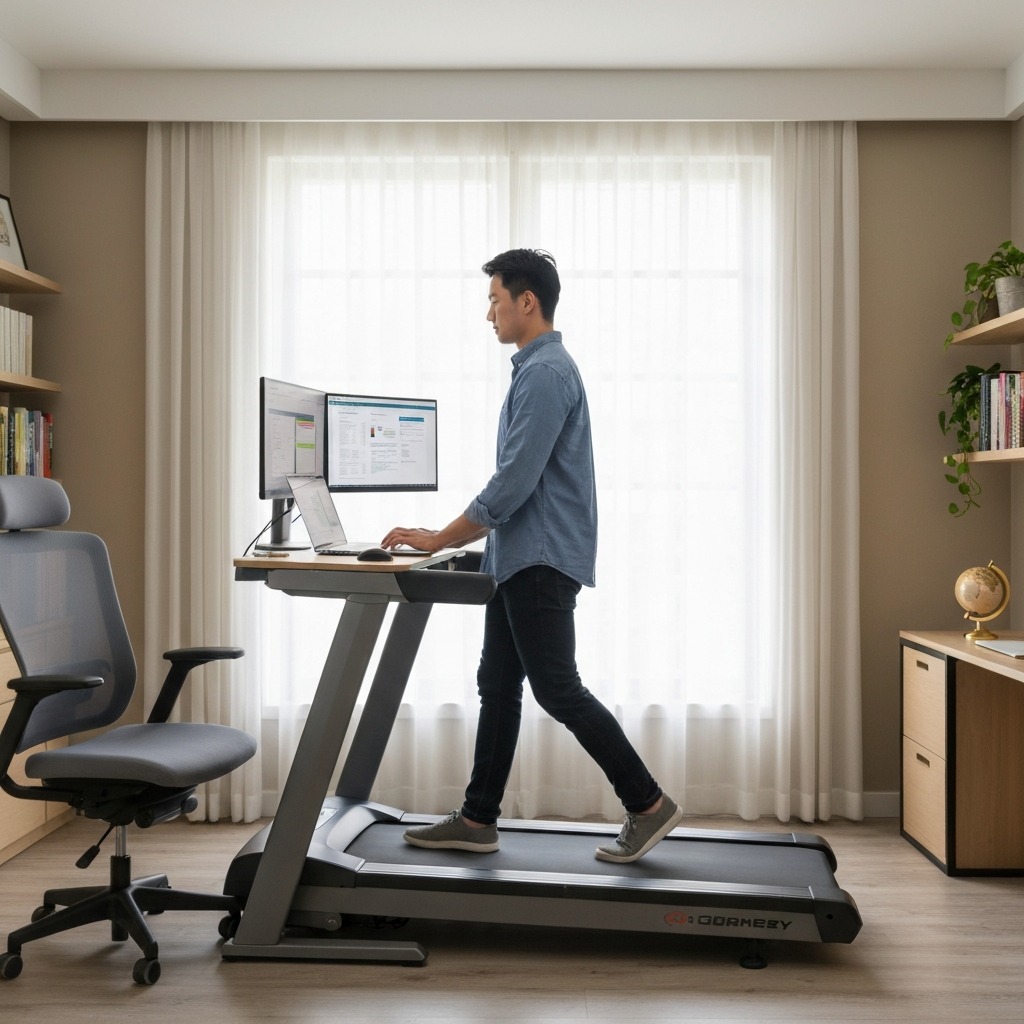
Home workers have a unique advantage: they control their environment. The commute is gone. The office is 10 feet away. The desk is theirs. This creates an opportunity that office workers do not have — integrating movement into the workday.
| Factor | Walking Pad for Home Workers | Treadmill for Home Workers |
|---|---|---|
| Usable during work | ✅ 3–5 hours/day while working | ❌ Requires dedicated time |
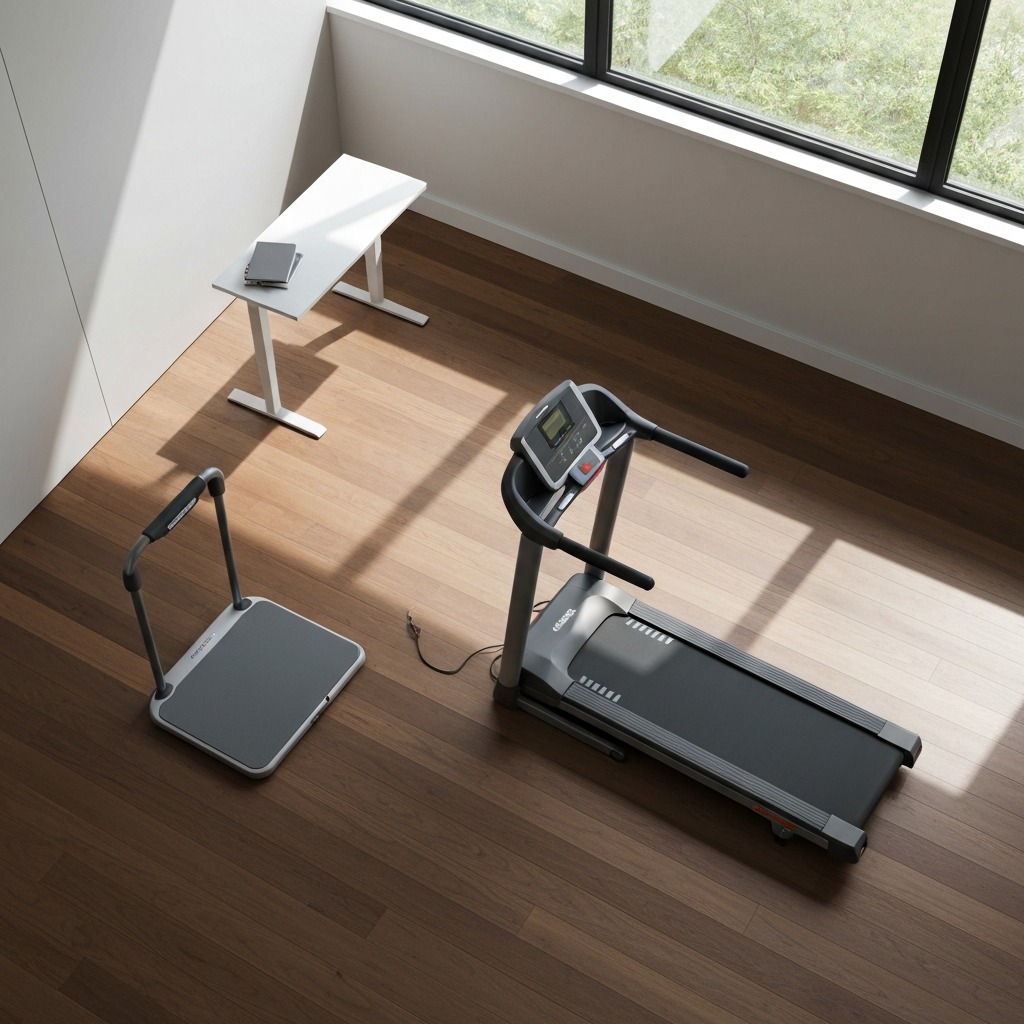
| Space | Slides under desk (2 sq ft stored) | Dedicated room corner (12–20 sq ft) |
| Noise during calls | ✅ Quiet at 1.5 mph; mute when not speaking | ❌ Too loud for any call |
| Time investment | 0 additional hours (replaces sitting) | 30–60 min/day (additional to work) |
| Mental energy | Zero — walking at 1.5 mph is effortless | Moderate — running requires motivation |
| After-work availability | Already exercised during work | Still need to find time/energy |
| Cost | $180–450 | $500–2,500 |
The Verdict for Home Workers
A walking pad is purpose-built for home workers. It converts sedentary work hours into active hours without requiring additional time, energy, or motivation. For weight loss specifically, the walking pad's lower per-hour burn is overwhelmed by its higher total weekly burn from integration into the workday.
A treadmill is a better exercise machine. But "better exercise machine" and "better for weight loss for a busy home worker" are different questions. The walking pad answers the second one.
Cost, Space, and Practicality
Full Cost Comparison
| Factor | Walking Pad | Treadmill |
|---|---|---|
| Equipment cost | $180–450 | $500–2,500 |
| Floor mat | $20–40 | $30–50 |
| Floor space (in use) | ~10 sq ft | 12–20 sq ft |
| Floor space (stored) | ~2 sq ft (folds or slides under desk) | 12–20 sq ft (most do not fold compactly) |
| Power consumption | ~100–200 watts | ~600–1,500 watts |
| Noise at use speed | 38–48 dB (conversation level) | 55–75 dB (vacuum to blender) |
| Assembly | Minimal (unfold and plug in) | Moderate to significant (30–90 min) |
| Maintenance | Belt lubrication every 3–6 months | Belt lubrication + calibration + more |
| Lifespan | 2–5 years (walking use) | 5–15 years (varies by quality) |
| Resale value | 30–50% at 1 year | 20–40% at 1 year |
The Space Reality
Many home workers do not have a spare room for a treadmill. A walking pad slides under a desk, a couch, or a bed. It shares the workspace rather than demanding its own. This practical constraint often decides the purchase more than calorie calculations.
The Best-of-Both Strategy
If You Can Have Both
| Time of Day | Equipment | Activity | Net Burn (155 lb) |
|---|---|---|---|
| 9 AM–12 PM | Walking pad | Walk at 1.5–2.0 mph while working | ~330–400 cal |
| 12:30 PM | Treadmill | 30-min run at 5 mph OR 30-min incline walk at 3 mph/10% | ~270–320 cal |
| 1–4 PM | Walking pad | Walk at 1.5 mph while working | ~220–330 cal |
| Daily total | — | — | ~820–1,050 net cal |
This produces approximately 4,000–5,000 net calories per week — equivalent to roughly 1.2–1.5 lbs of fat per week, or 5–6 lbs per month (before dietary compensation adjustment).
If You Can Only Have One
Buy the walking pad if:
- You work from home and struggle to find dedicated exercise time
- You prioritize consistency over intensity
- Space is limited
- Budget is under $500
- You have never maintained a treadmill habit for more than 3 months
Buy the treadmill if:
- You already have an established running habit
- You want to do HIIT, incline training, or serious running
- You have dedicated space for equipment
- You have consistent dedicated exercise time in your schedule
- Walking 1.5–2.0 mph feels too slow to be satisfying
For walking pad sizing and selection, see our best budget walking pads guide. For noise considerations in shared spaces, see our quietest walking pads guide.
Frequently Asked Questions
Is a walking pad or treadmill better for weight loss?
Treadmill burns more per hour. Walking pad burns more per week for most people because you use it 3–5 hours daily during work versus 30–45 minutes of dedicated treadmill time. Consistency wins for weight loss.
How many more calories does a treadmill burn?
Per hour: a treadmill at 6 mph burns ~3× a walking pad at 2 mph. But per week, 3 hours of daily walking pad use (5 days) often exceeds 3–4 treadmill sessions of 30–45 minutes.
Can you lose weight with just a walking pad?
Yes — approximately 1–2 lbs per month at 2–3 hours daily without diet changes. Over a year, 12–24 lbs. Modest but meaningful and sustainable.
Does a walking pad burn enough to matter?
Yes. 3 hours at 1.5 mph = ~330 net extra calories per day. Per week: ~1,650. Per month: ~1.9 lbs of fat. The alternative (sitting) burns zero extra.
Is incline walking better for weight loss?
Yes — 3 mph at 10% incline burns ~80% more than flat. But incline requires a treadmill and dedicated exercise time. You cannot incline-walk while working.
Can I do HIIT on a walking pad?
No. Walking pads max at 3.5–4 mph with no incline. HIIT requires sprinting speed, rapid changes, and optionally incline. You need a treadmill for HIIT.
Which suits home workers better?
Walking pad — it converts work hours into active hours with zero additional time. A treadmill requires stopping work to exercise.
Should I buy both?
If space and budget allow, yes. Walking pad for daily integrated movement (3–5 hours). Treadmill for dedicated exercise (30–45 min, 3–4×/week). Combined, they produce the highest total calorie burn.
Sources and Methodology
This guide compares walking pads and treadmills for weight loss using MET-based calorie calculations and exercise adherence research.
Calorie Calculations:
- Compendium of Physical Activities (Ainsworth et al.) — MET values for walking at various speeds and inclines, jogging, and running
- Formula: Calories/hour = MET × weight(kg) × 1.05
- Net calories = total calories minus sitting baseline (MET 1.0)
- 1 lb body fat ≈ 3,500 calories
Exercise Adherence Research:
- Approximately 50% of new exercisers quit within 6 months — consistent finding across exercise psychology literature
- Time is the most commonly cited barrier to exercise — CDC, ACSM
- Exercise integrated into existing routines has higher adherence than dedicated exercise sessions — behavioral science research
Health References:
- CDC: Physical Activity Guidelines — 150 min/week moderate activity for adults — cdc.gov
- ACSM: Guidelines for Exercise Testing and Prescription — exercise intensity, duration, and weight management
Methodology notes:
- Weight loss projections use MET-calculated calorie burn minus sitting baseline; assume no dietary compensation
- Dietary compensation typically reduces actual fat loss to 40–60% of calculated projection
- Adherence estimates are approximations based on general exercise dropout research; individual adherence varies
- Incline calorie estimates use validated MET values for graded walking from the Compendium
- "Home worker" scenarios assume 8-hour workday with flexibility to use walking pad during work
- This guide provides fitness and weight management information, not medical or dietary advice
- We may earn a commission on purchases at no additional cost to you; affiliate relationships do not influence recommendations
Internal links referenced:
- Walking Pad Calories Burned
- Walking Pad vs Exercise Bike
- Best Budget Walking Pads
- Quietest Walking Pads
Visual Guide Gallery