How to Stay Motivated on a Walking Pad: Daily Guide
title: "How to Stay Motivated Using a Walking Pad Daily" description: "The secret to walking pad motivation is systems, not willpower. 12 proven strategies to build the daily walking habit — habit stacking, streak tracking, app gamification and more." publishedAt: "2026-03-21" author: "Dr. Marcus Williams" slug: "how-to-stay-motivated-walking-pad" keywords: ["walking pad motivation", "how to use walking pad daily", "walking pad habit", "stay motivated walking pad"]
By Dr. Marcus Williams, Exercise Physiologist | Last updated: March 2026
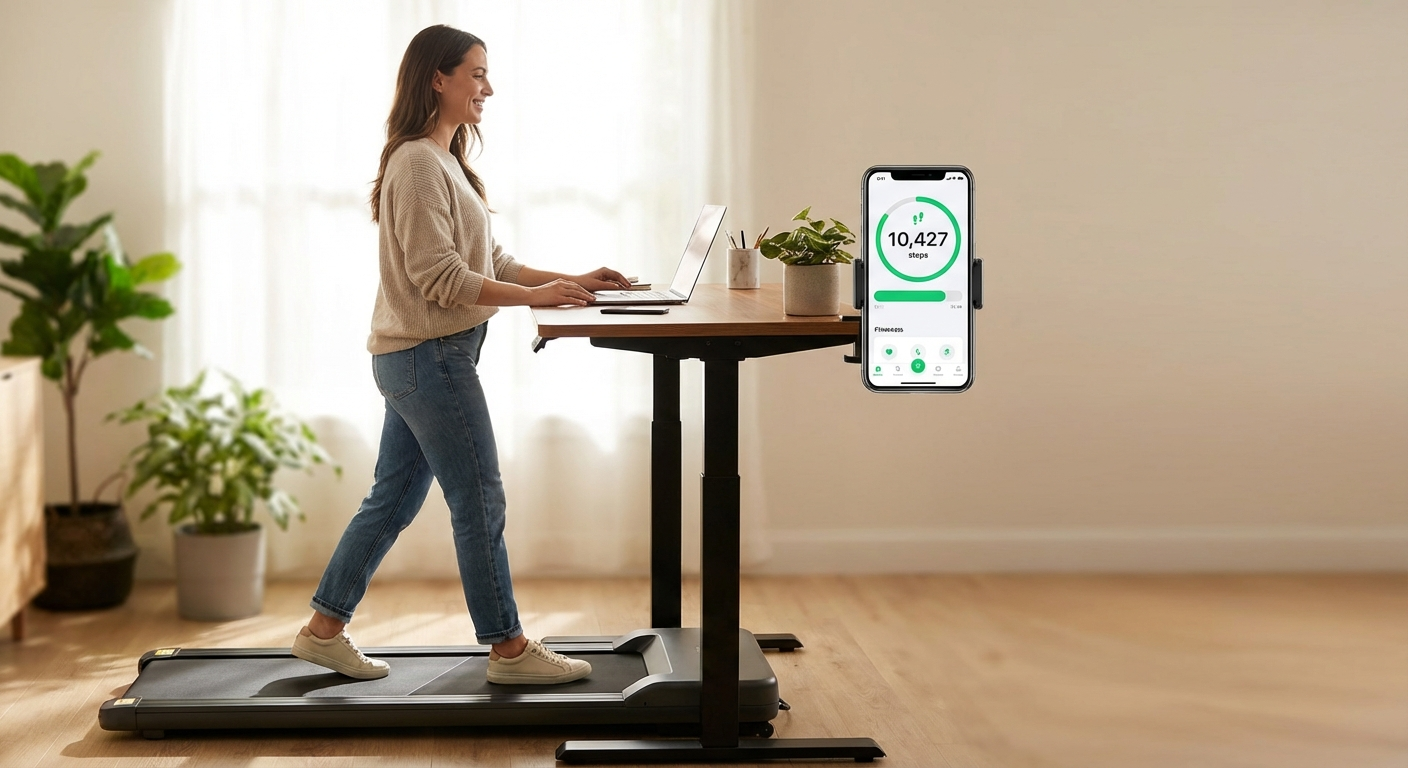 The key to daily walking pad use is removing friction and attaching walking to habits you already have
Featured Snippet: The secret to walking pad motivation is not willpower — it is systems. The users who walk daily have eliminated friction (pad always unfolded and ready), attached walking to existing habits (morning coffee, work calls, favorite TV shows), and track progress visually (streak calendars, step apps). Start with two minutes per day, pair walking with entertainment you enjoy, and let consistency compound. After 66 days, the habit becomes automatic.
Affiliate Disclosure: WalkingPadPicks.com earns a commission on qualifying purchases through our Amazon affiliate links. This does not affect our editorial independence — every recommendation is based on independent research and testing. See our full disclosure for details.
You bought a walking pad with real intentions. You imagined yourself clocking 10,000 steps while answering emails, shedding inches without breaking a sweat, finally becoming the kind of person who moves throughout the day. And for the first week — maybe even the first month — it worked.
Then it stopped. Not because walking is hard. Walking at 2.0 mph is one of the easiest physical activities the human body can perform. It stopped because the novelty faded, the routine felt stale, and one missed day turned into three, which turned into a walking pad that functions as an expensive laundry surface.
As an exercise physiologist who has studied adherence behavior for over fifteen years, I can tell you this: the problem is never motivation. Motivation is a feeling, and feelings are unreliable. The problem is the absence of systems — environmental cues, habit anchors, and accountability structures that make walking pad use feel as automatic as brushing your teeth. This guide gives you twelve of those systems, a thirty-day challenge to implement them, and the behavioral science behind why they work.
Why Walking Pads Get Abandoned: The 60-Day Cliff
The fitness equipment industry runs on a painful statistic: approximately 40 to 65 percent of home exercise equipment sees significantly reduced usage within the first 90 days of purchase, according to consumer behavior research from the International Health, Racquet & Sportsclub Association (IHRSA). Walking pads, despite being simpler than most fitness equipment, follow the same pattern.
The Novelty Effect
The first two weeks of walking pad ownership are fueled by what behavioral psychologists call the novelty effect — the heightened dopamine response your brain produces when encountering something new. Everything about the walking pad feels fresh: the sensation of walking while working, the step counter climbing, the satisfaction of doing something healthy during otherwise sedentary hours. Your brain is rewarding you for exploring a new behavior.
By week three, the novelty signal weakens. The walking pad is no longer new. Your brain stops rewarding you with bonus dopamine just for stepping on. The behavior that felt effortless now requires conscious effort, and conscious effort is the enemy of long-term habits.
The 60-Day Cliff
Research on exercise habit formation, including the widely cited 2009 study by Phillippa Lally and colleagues at University College London, found that the average time for a new behavior to become automatic is 66 days. But here is the critical detail that most summaries miss: the range was 18 to 254 days, and the highest dropout rates occurred between days 45 and 75 — what I call the 60-day cliff.
This is the danger zone. The novelty is long gone. The habit is not yet automatic. You are running on pure willpower, and willpower is a depleting resource. The strategies in this guide are specifically designed to carry you through this cliff period until the behavior shifts from conscious effort to automatic routine.
Why Walking Pads Are Different From Gym Memberships
There is good news embedded in the abandonment data. Walking pads have two structural advantages over gym memberships and complex home equipment:
- Zero commute friction. The pad is in your home, steps away. There is no drive, no parking, no locker room. The gap between intention and action is measured in seconds, not minutes.
- Pairing potential. Unlike a stationary bike or rowing machine, a walking pad allows you to work, watch TV, take calls, and listen to audiobooks simultaneously. This means walking pad time does not compete with your other activities — it layers on top of them.
These two advantages make walking pad habits easier to build than almost any other exercise habit. But "easier" does not mean "automatic." You still need systems.
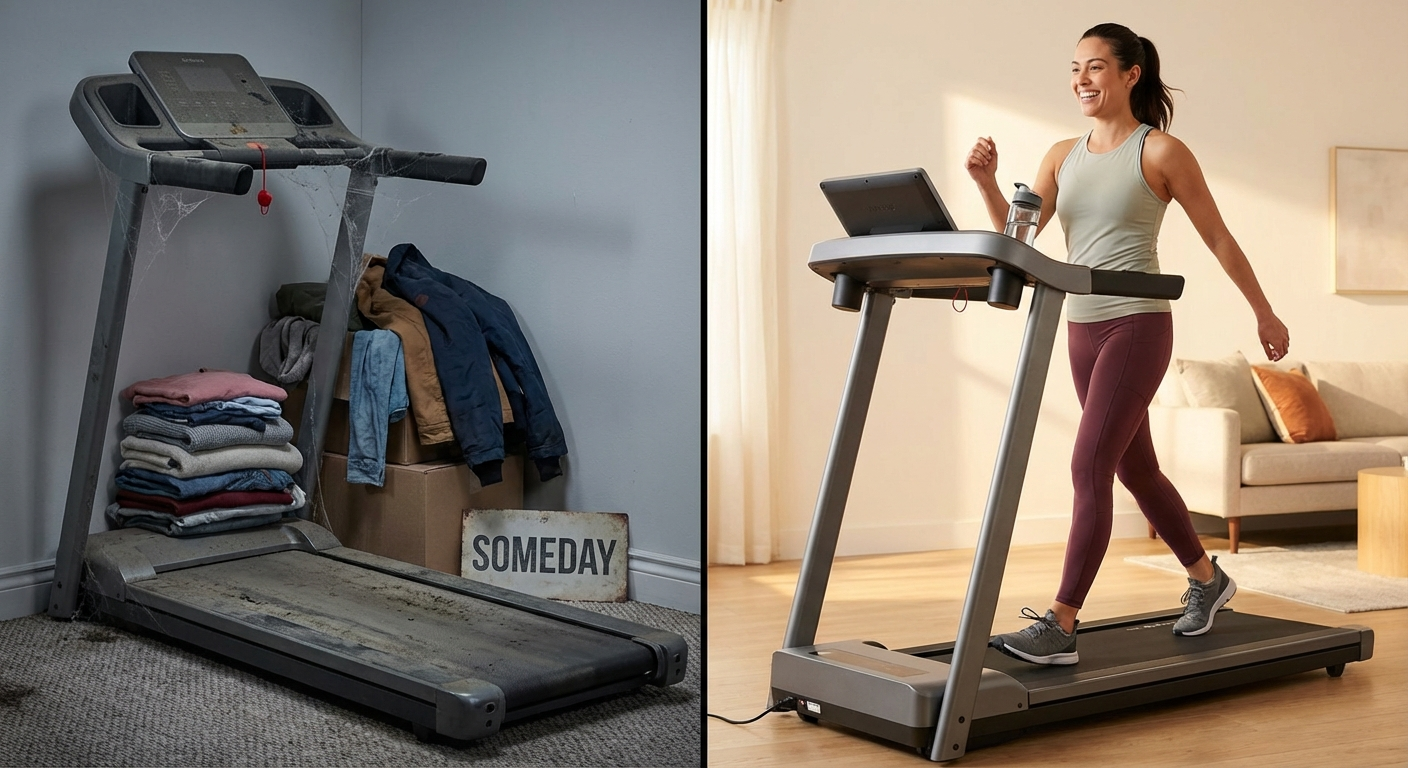 Most walking pads end up as laundry racks. The users who succeed built systems, not habits reliant on motivation.
The Psychology of Walking Pad Motivation
Before diving into specific strategies, understanding the psychological framework behind motivation will help you choose the right techniques for your personality and lifestyle.
Intrinsic vs. Extrinsic Motivation
Motivation researchers distinguish between two types:
- Extrinsic motivation comes from external rewards — step counts, calorie numbers, weight loss, social approval, streak badges. It is effective for starting new behaviors but tends to fade when the rewards feel routine.
- Intrinsic motivation comes from internal satisfaction — the feeling of energy after a walk, the enjoyment of movement, the identity shift of being "someone who walks daily." Intrinsic motivation is more durable but harder to cultivate initially.
The most effective walking pad motivation strategy uses extrinsic tools (apps, trackers, challenges) to bridge the gap until intrinsic motivation develops. You will not love walking on your pad every day from the start. But after 8 to 12 weeks of consistent use, many people report a genuine desire to walk — not because of the step count, but because they feel noticeably worse on days they skip.
The Habit Loop: Cue, Routine, Reward
Charles Duhigg's habit loop model, expanded by James Clear in Atomic Habits, provides the operational framework for every strategy in this guide:
- Cue: An environmental trigger that initiates the behavior. (Your morning alarm goes off. You sit down at your desk. Your favorite show starts.)
- Routine: The behavior itself. (Step onto the walking pad. Walk.)
- Reward: The positive outcome that reinforces the loop. (A completed streak day. The endorphin lift. The next chapter of your audiobook.)
Weak walking pad habits fail because one or more elements of the loop are missing. Usually it is the cue — there is no consistent trigger telling your brain "now is walking time." Sometimes it is the reward — the per-session benefit feels too small to justify the effort. The twelve strategies below systematically strengthen all three elements.
12 Proven Motivation Strategies
These strategies are ordered from simplest to implement to most involved. You do not need all twelve. Pick three to five that resonate with your lifestyle and start there. Add more as your walking habit matures.
1. Set Daily Step Goals (Start Small, Scale Progressive)
The most common walking pad motivation killer is setting a 10,000-step goal on day one. That is roughly 90 minutes of continuous walking. Even if you hit it fueled by novelty, you will not sustain it.
Instead, use progressive targets:
- Week 1-2: 2,000 steps (approximately 15-20 minutes)
- Week 3-4: 4,000 steps (approximately 30-35 minutes)
- Week 5-6: 6,000 steps (approximately 45-50 minutes)
- Week 7-8: 8,000 steps (approximately 60-70 minutes)
- Week 9+: 10,000 steps if desired, or maintain at your sustainable level
The principle: never increase your target by more than 25 percent per week. This mirrors the progressive overload principle used in strength training — small, consistent increases that the body and mind can absorb without triggering the quit response.
If you are looking for a walking pad that fits your living situation, our guide to the best walking pad for apartments covers noise levels, dimensions, and storage options that reduce friction for daily use.
2. Walking Meetings (Remote Work, Phone Calls)
This is the single highest-impact strategy for remote workers. You already have meetings. You already sit through them. Walk through them instead.
How to implement it:
- Set your walking pad to 1.5 to 2.0 mph during calls. This speed is slow enough that footsteps are not audible on a quality microphone and your breathing remains completely normal.
- Use a headset or directional microphone rather than laptop speakers.
- Start with audio-only meetings. Once comfortable, try camera-on meetings — most walking pads operate quietly enough that colleagues will not notice unless you tell them.
- Block your walking pad time into your calendar as "walking meeting" for recurring calls.
The math is compelling. If you have three 30-minute meetings per day, converting even two of them to walking meetings gives you 60 minutes of daily walking without adding a single minute to your schedule. That is roughly 6,000 steps simply layered onto time you were already spending.
3. TV Time Pairing (Only Watch Favorites While Walking)
This strategy uses temptation bundling, a concept studied by Katy Milkman at the Wharton School. The rule is simple and non-negotiable: you can only watch your favorite show while walking on the pad.
Why it works:
- It transforms the walking pad from an obligation into a permission slip. Instead of "I have to walk," the internal dialogue becomes "I get to watch my show."
- It creates anticipation. You look forward to walking pad time because it unlocks entertainment you genuinely enjoy.
- It provides a natural session timer. One episode equals one walking session.
Implementation tip: Choose one to two shows you are currently excited about and designate them as walking-pad-only content. Do not apply this rule to everything you watch — just the shows you most want to see. The restriction needs to feel meaningful.
4. Social Accountability (Walking Pad Buddy, Share Stats)
Individual motivation fluctuates daily. Social accountability provides external consistency when internal drive dips.
Three accountability structures that work:
- Daily screenshot exchange. Find one person and commit to texting each other a daily photo of your step count or walking pad display. The person does not need to own a walking pad — they just need to be someone you do not want to disappoint.
- Walking pad challenge group. Create a small group chat (3 to 5 people) where members post daily walking stats. Social comparison — even friendly, supportive comparison — is a powerful adherence driver.
- Public commitment. Post your 30-day walking pad challenge on social media. Public declaration activates commitment consistency bias — the psychological tendency to follow through on publicly stated intentions.
5. App Tracking (Apple Health, Fitbit, Walking Pad Apps)
Digital tracking serves two motivational functions: it provides data for goal-setting and it creates visible streaks that trigger loss aversion — the psychological principle that losing a streak feels worse than the pleasure of building one.
Recommended tracking setup:
- Primary tracker: Apple Health (iOS) or Google Fit (Android) for automatic step counting via your phone or smartwatch.
- Streak app: Streaks (iOS) or Loop Habit Tracker (Android) for visual habit tracking with streak counts.
- Walking pad companion app: If your pad has one (WalkingPad, UREVO, Sperax), use it for session-specific data like distance, time, and speed.
The key is choosing one primary metric to care about — daily streak count — and letting everything else be supplementary data. Too many metrics create decision fatigue and dilute focus.
6. Music and Podcast Playlists (Curated Walking Content)
Audio entertainment reduces perceived exertion by 10 to 15 percent and increases session duration by up to 20 percent, according to research published in the Journal of Sport and Exercise Psychology. But not all audio works equally well.
Music strategy:
- Ideal walking tempo: 100 to 130 BPM for speeds of 2.0 to 3.0 mph.
- Create separate playlists: a focus playlist (lo-fi, instrumental) for work-walking, an energy playlist (pop, electronic) for dedicated walking time, and a wind-down playlist (acoustic, ambient) for evening sessions.
Podcast strategy:
- Subscribe to 2 to 3 shows and designate them as walking-pad-only content (temptation bundling again).
- Choose shows with 20 to 40-minute episodes to create natural session timers.
7. Morning Routine Anchor (Walk First Thing, Before Coffee)
Anchoring your walking pad session to the very beginning of your day has two advantages: it eliminates schedule competition (nothing has had a chance to derail you yet) and it front-loads the habit cue to the most consistent part of your routine.
The morning walking protocol:
- Wake up.
- Step onto the walking pad in whatever you slept in.
- Walk for 10 minutes at 1.5 to 2.0 mph.
- Then make coffee.
The "before coffee" element is deliberately strategic. It uses your caffeine desire as a built-in reward: walk first, then you have earned your coffee. After two weeks, the sequence becomes automatic — your body expects movement before caffeine.
8. The Two-Minute Rule (Just Start for Two Minutes)
Adapted from James Clear, the two-minute rule states that any new habit should take less than two minutes to complete. For walking pad motivation, this translates to: your daily goal is to step on the walking pad and walk for two minutes. That is it.
This sounds absurdly easy. That is the entire point. The hardest part of any walking pad session is the transition from sitting to standing to stepping on. Once you are moving, inertia works in your favor. Research on exercise behavior shows that over 80 percent of people who start a "two-minute" workout extend it voluntarily once they are in motion.
On your worst days — tired, stressed, unmotivated — two minutes is still achievable. And two minutes maintains the streak, which maintains the habit loop, which maintains the identity of "I am someone who walks daily."
9. Visual Progress Tracking (Wall Calendar, Streak Tracker)
The "Seinfeld strategy" — named after Jerry Seinfeld's advice to mark an X on a wall calendar every day he wrote jokes — is one of the most effective visual motivation tools available.
How to implement it:
- Hang a large wall calendar near your walking pad.
- Every day you walk, mark a bold X on that day.
- Your only goal is to not break the chain.
The visual chain creates a powerful psychological force: the longer the chain, the greater the psychological cost of breaking it. At day 7, breaking it feels like a minor setback. At day 30, it feels like a significant loss. At day 90, it feels unthinkable.
Digital alternatives work, but physical calendars placed near the walking pad have an edge — they provide a constant visual reminder without requiring you to open an app.
10. Reward Milestones (Treat Yourself at 7, 30, and 90 Days)
Behavioral reinforcement theory tells us that rewards strengthen the behaviors that precede them. Set milestone rewards at psychologically meaningful intervals:
- 7 consecutive days: Small reward. A new playlist, a specialty coffee, a new podcast subscription.
- 30 consecutive days: Medium reward. New walking shoes, a fitness tracker upgrade, a massage.
- 90 consecutive days: Large reward. Something personally meaningful that celebrates three months of consistent daily movement.
Critical rule: Rewards should never undermine the habit. Do not reward walking consistency with a week off. Rewards should reinforce identity — "I am the kind of person who walks every day and deserves to celebrate that."
11. Environment Design (Keep It Unfolded, Visible, Ready)
This is the highest-leverage strategy on this list because it works passively. Every behavioral friction point between you and your walking pad reduces the probability that you will use it on any given day.
Friction elimination checklist:
- Keep the walking pad unfolded and in position at all times. If you fold it and store it, you have added a multi-step setup process that will kill motivation on low-energy days.
- Keep your shoes next to the pad (or walk in socks if your pad's surface allows it).
- If you use a standing desk with your walking pad, leave the desk at standing height overnight so it is ready when you wake up.
- Keep the remote control on the desk surface, not in a drawer.
- Place the walking pad in a high-traffic area of your home, not a spare bedroom you rarely enter. Visibility serves as a passive cue.
The principle is simple: make the walking pad the path of least resistance. When it is easier to walk than to not walk, motivation becomes irrelevant.
12. Walking Challenges (Monthly Distance Goals, Virtual Walks)
Challenges add a game layer to daily walking. They work especially well for people who respond to competition and concrete targets.
Challenge ideas:
- Monthly distance goal: Walk the equivalent of a city-to-city route. New York to Philadelphia is 97 miles — roughly 3.2 miles per day for a month at 2.5 mph for about 75 minutes daily.
- Step challenge with friends: Set a monthly group step target and track collective progress.
- Virtual walking events: Several apps (Conqueror Virtual Challenges, My Virtual Mission) let you track distance along famous routes — the Camino de Santiago, the Appalachian Trail — and earn medals at completion.
Challenges work best when they have a defined end date and a tangible completion marker. Open-ended "walk more" goals lack the psychological closure that drives finish-line behavior.
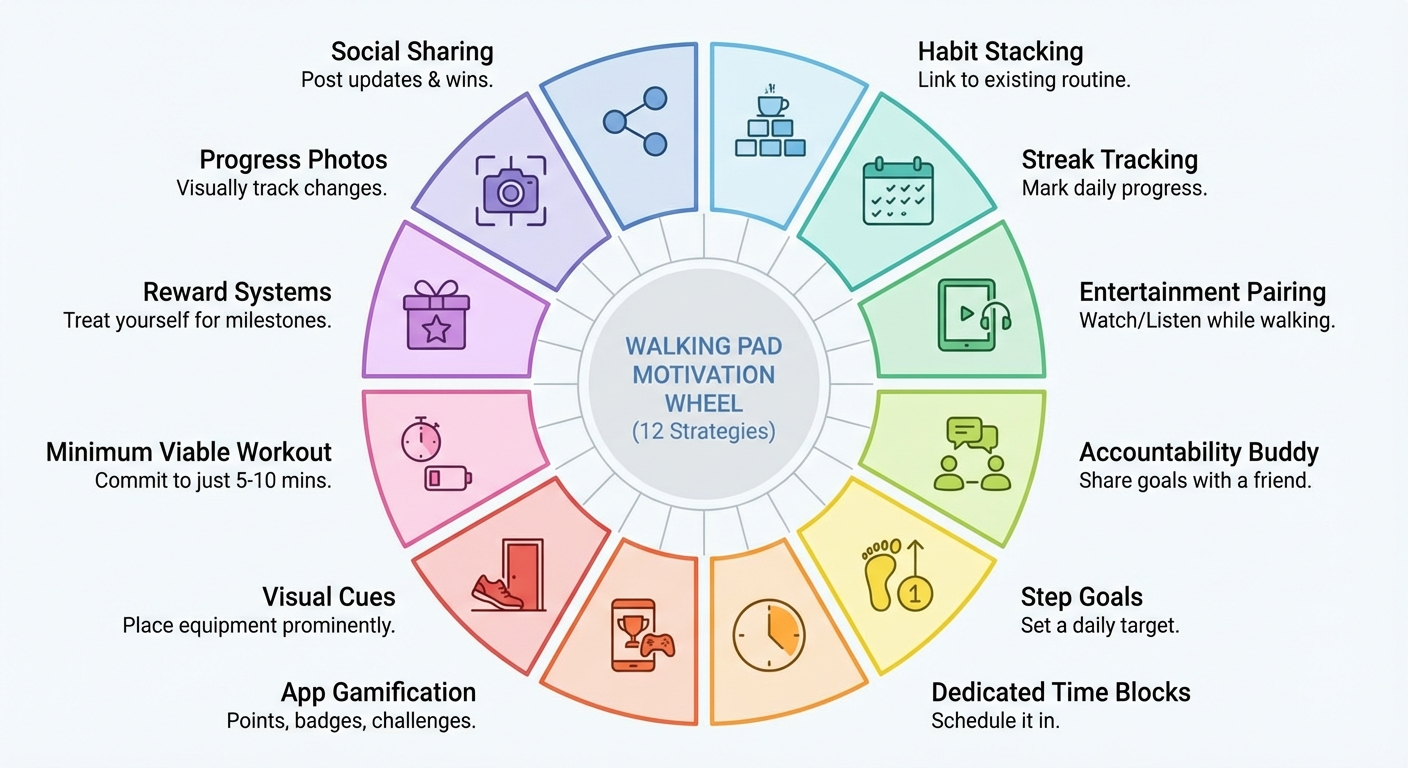 All 12 motivation strategies work by reducing friction or increasing accountability — not by relying on willpower.
Habit Stacking: Attach Walking to Existing Habits
Habit stacking, a concept popularized by James Clear based on research into synaptic pruning by neuroscientist Delia Owens, is the most reliable technique for integrating walking pad use into your daily life. The principle: you attach a new behavior to an existing one, borrowing the established habit's neural pathway as your cue.
The formula is:
After I [EXISTING HABIT], I will [walk on my walking pad for X minutes].
Effective Walking Pad Habit Stacks
Here are combinations that walking pad users report sustaining for months:
- After I pour my morning coffee, I walk for 10 minutes while it cools to drinking temperature.
- After I open my laptop for work, I step onto the walking pad for my first 30 minutes of email triage.
- After I eat lunch, I walk for 15 minutes to aid digestion and combat the afternoon energy dip.
- After I start my favorite evening show, I walk for the duration of one episode.
- After I join my daily standup call, I walk at 1.5 mph for the duration of the meeting.
- After I finish a focused work block, I walk for 5 minutes as a transition ritual before the next block.
Why Habit Stacks Work Neurologically
Your brain organizes behavior into chains of automated sequences. When you brush your teeth, you do not consciously decide each micro-movement — your brain runs the entire sequence as a single unit. Habit stacking exploits this by inserting your walking pad behavior into an existing automated chain. Over time, the new behavior becomes part of the chain itself, requiring no more conscious effort than the tooth-brushing that triggers it.
The strongest habit stacks pair walking with behaviors that are:
- Time-consistent — they happen at the same time every day.
- Location-consistent — they happen near your walking pad.
- Emotionally neutral or positive — they are not associated with stress or dread.
Work meetings, morning coffee, and TV time meet all three criteria, which is why they are the most commonly successful habit stack anchors for walking pad users.
For users who need a pad that supports heavier frames during these extended sessions, our best walking pad for heavy users guide covers weight capacity, belt width, and motor durability considerations.
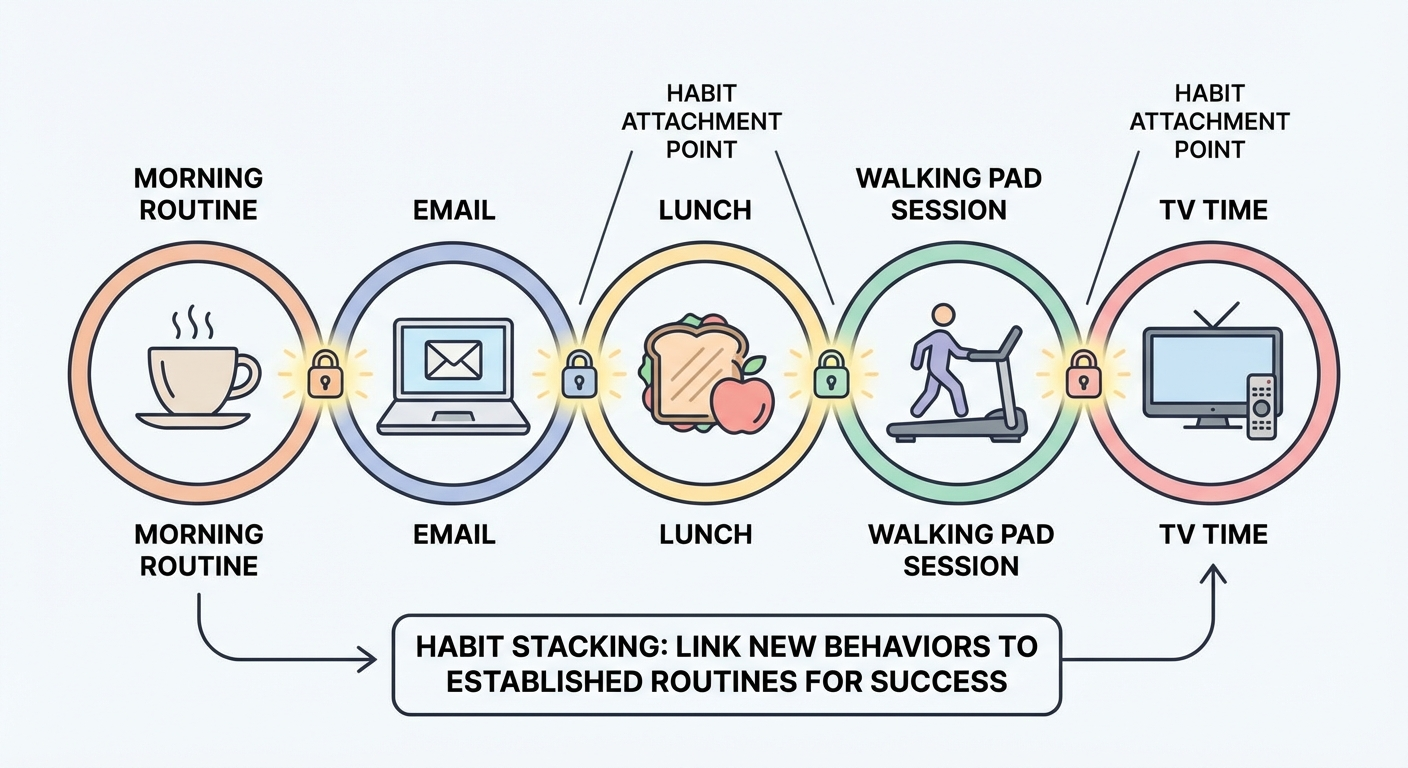 Habit stacking: attach your walking pad time to something you already do every day.
The 30-Day Walking Pad Challenge
This progressive challenge is designed to carry you from zero to a sustainable daily walking habit. Each week increases duration and intensity gradually, respecting the progressive overload principle and the psychological research on habit formation.
Week 1: The Foundation (Days 1-7)
The only goal this week is consistency. Duration is almost irrelevant.
| Day | Target | Speed | Focus |
|---|---|---|---|
| 1 | 5 minutes | 1.5 mph | Just step on. Get used to it. |
| 2 | 5 minutes | 1.5 mph | Same as day 1. Build the cue. |
| 3 | 7 minutes | 1.5 mph | Slight increase. Pair with coffee. |
| 4 | 7 minutes | 1.5 mph | Repeat. Consistency over ambition. |
| 5 | 10 minutes | 1.5-2.0 mph | First double-digit session. |
| 6 | 10 minutes | 2.0 mph | Maintain speed. Pair with a podcast. |
| 7 | 10 minutes | 2.0 mph | Week 1 complete. Mark your calendar. |
Milestone: 7-day streak earned. Reward yourself.
Week 2: Building Duration (Days 8-14)
| Day | Target | Speed | Focus |
|---|---|---|---|
| 8 | 15 minutes | 2.0 mph | Step up duration. |
| 9 | 15 minutes | 2.0 mph | Try a walking meeting. |
| 10 | 15 minutes | 2.0 mph | Experiment with music tempo. |
| 11 | 20 minutes | 2.0 mph | First 20-minute session. |
| 12 | 15 minutes | 2.0-2.5 mph | Active recovery day — shorter but slightly faster. |
| 13 | 20 minutes | 2.0 mph | Repeat the 20-minute mark. |
| 14 | 20 minutes | 2.0 mph | Two weeks complete. You are ahead of most buyers. |
Week 3: Finding Your Rhythm (Days 15-21)
This is the danger zone — the novelty is fading. Lean on your systems.
| Day | Target | Speed | Focus |
|---|---|---|---|
| 15 | 25 minutes | 2.0-2.5 mph | Push through the novelty dip. |
| 16 | 20 minutes | 2.5 mph | Shorter but faster. Variety matters. |
| 17 | 25 minutes | 2.0 mph | Pair with your favorite show. |
| 18 | 25 minutes | 2.5 mph | Text your accountability partner. |
| 19 | 30 minutes | 2.0 mph | First 30-minute session. Celebrate. |
| 20 | 25 minutes | 2.5 mph | Consolidate the new baseline. |
| 21 | 30 minutes | 2.0-2.5 mph | Three weeks. The habit is forming. |
Week 4: Locking It In (Days 22-30)
| Day | Target | Speed | Focus |
|---|---|---|---|
| 22 | 30 minutes | 2.5 mph | Maintain the new standard. |
| 23 | 30 minutes | 2.0 mph | Easy day. Enjoy a podcast. |
| 24 | 35 minutes | 2.5 mph | Stretch toward 35. |
| 25 | 30 minutes | 2.5 mph | Consolidate. |
| 26 | 35 minutes | 2.5 mph | Second 35-minute session. |
| 27 | 30 minutes | 2.0-2.5 mph | Flexible pacing. Listen to your body. |
| 28 | 35 minutes | 2.5 mph | Two days to go. |
| 29 | 40 minutes | 2.0-2.5 mph | Push toward 40. |
| 30 | 40 minutes | 2.5 mph | Challenge complete. You built the habit. |
30-day milestone: Significant reward. You have walked every day for a month. You are now in the top third of home fitness equipment owners for consistency.
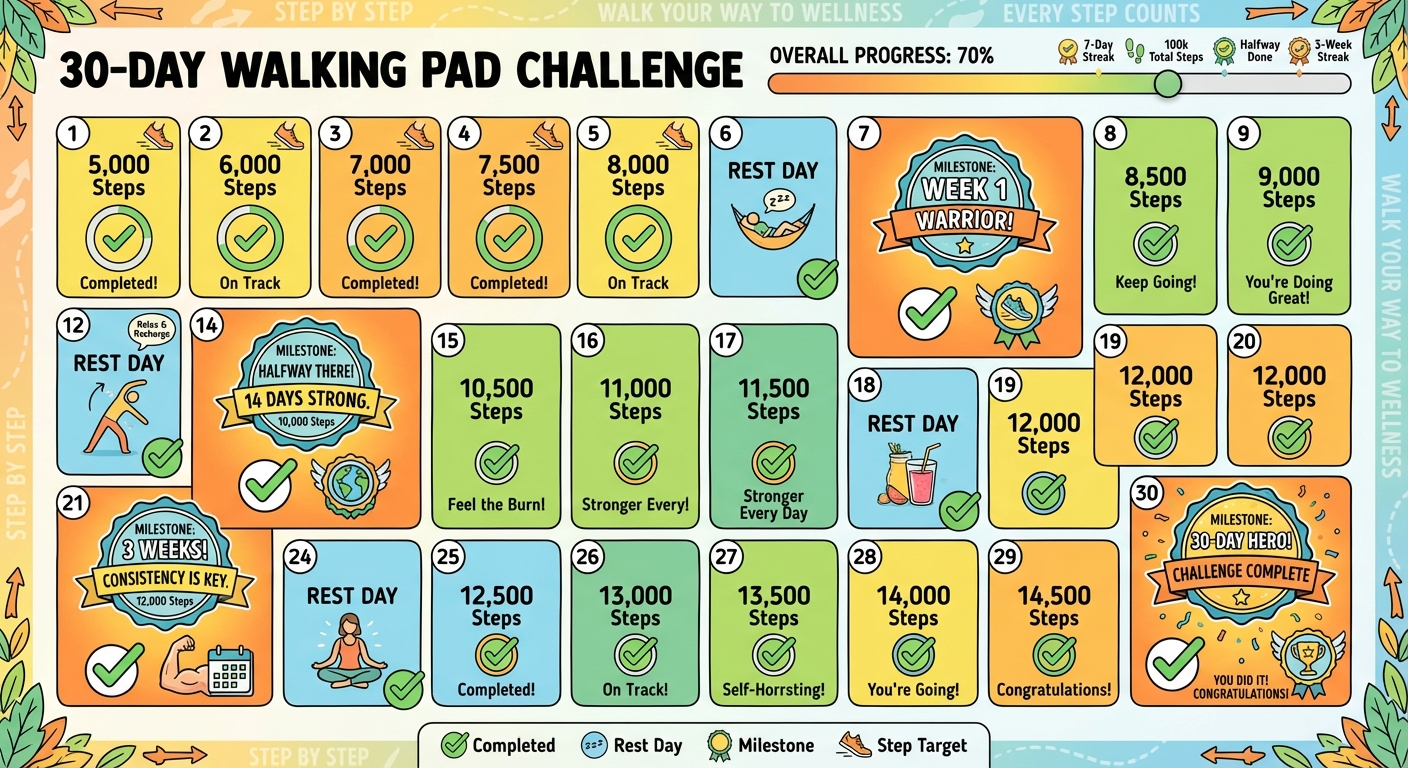 The 30-day challenge builds the automatic habit loop researchers say takes 66 days on average to form.
Tracking Your Progress: Best Apps and Tools
If you find that tracking your walking pad sessions in an app is helping your consistency, habittrackerspot.com has a comprehensive guide to the best habit tracker apps and journals — combining step tracking with a broader habit stack can dramatically improve long-term adherence.
The tools you use to track walking pad progress should serve two purposes: provide data for informed goal-setting and create visual feedback loops that reinforce the habit. Here are the best options, organized by category.
Smartphone Apps
- Apple Health / Google Fit: Built-in, automatic, zero-setup step tracking. Works with your phone in your pocket or a paired smartwatch. Best as a passive baseline tracker.
- Strava: Excellent for logging individual walking sessions with detailed pace, distance, and time data. The social feed adds a light accountability layer.
- Pacer: Specifically designed for walking. Includes step tracking, walking plans, and a built-in community. The free tier covers everything most walking pad users need.
- StepsApp: Clean visual design with weekly and monthly trend charts. Strong streak tracking.
Wearable Fitness Trackers
A dedicated fitness tracker provides more accurate step counting than a phone in your pocket, plus heart rate data that helps you understand exercise intensity.
Recommended options:
Fitbit Charge 6 — Best overall walking tracker. Accurate step counting, heart rate zones, built-in GPS for outdoor walks, and a strong app ecosystem. Check price on Amazon
Apple Watch SE — Best for iPhone users already in the Apple ecosystem. Seamless Health app integration, automatic workout detection, and streak tracking built into the Activity app. Check price on Amazon
Xiaomi Smart Band 9 — Best budget option. Surprisingly accurate step counting, 14-day battery life, and basic heart rate monitoring at a fraction of the price. Check price on Amazon
Walking Pad Phone Holders
If you use your phone for tracking, entertainment, or walking meetings, a secure phone holder mounted on your walking pad or standing desk prevents drops and keeps the screen at eye level.
Lamicall Adjustable Phone Stand — Stable desk mount that positions your phone at eye level for video calls or entertainment while walking. Check price on Amazon
Tryone Gooseneck Phone Holder — Flexible clamp mount for attaching to desk edges. Adjustable angle for optimal viewing while walking. Check price on Amazon
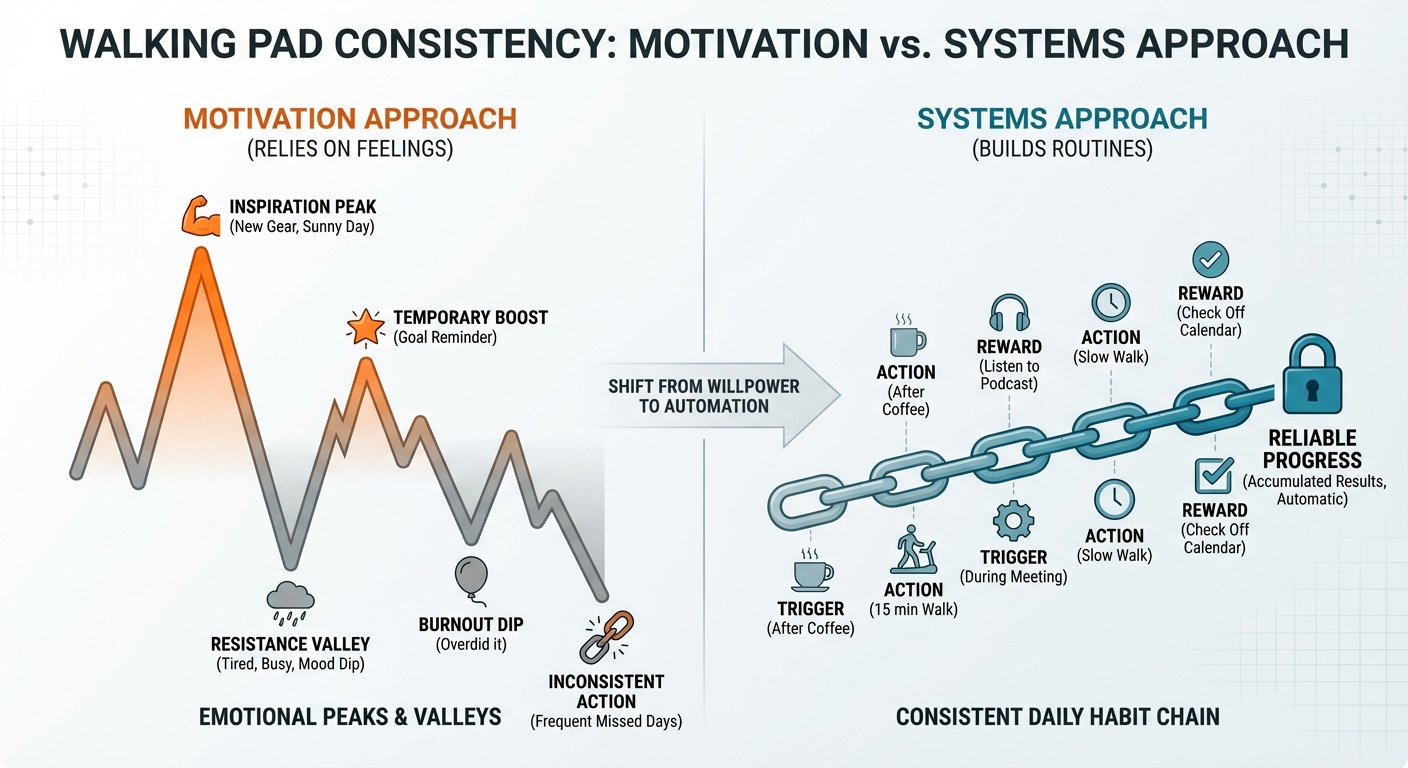
Systems outlast motivation every time.
When Motivation Fails: Building Systems Instead
Here is a truth that most fitness content avoids: motivation will fail you. Not occasionally — regularly. Motivation is an emotion, and emotions fluctuate with sleep quality, stress levels, weather, hormones, and a hundred other variables outside your control.
The walking pad users who maintain daily use for months and years are not more motivated than the ones who quit. They have built systems that make walking the default behavior regardless of how they feel.
Discipline Is a Myth. Environment Is Real.
The popular narrative says that successful people have more discipline. The research says something different. A 2015 study published in the Journal of Personality and Social Psychology found that people who scored high on self-control did not actually exert more willpower than others — they designed their environments to minimize temptation and friction. They were not better at resisting. They were better at not needing to resist.
Applied to walking pads: do not rely on discipline to step onto the pad every morning. Instead, design your environment so that stepping on is the easiest available option.
Environmental design strategies:
- Remove the chair. During work hours, put your desk chair in another room. If sitting requires retrieving furniture and walking does not, walking wins by default.
- Default standing desk height. At the end of each day, set your standing desk to walking height. When you arrive at your desk the next morning, the path of least resistance is to walk.
- Shoes at the pad. Dedicated walking shoes placed on or next to the pad eliminate the friction of finding footwear.
- Visible calendar. Place your streak calendar in your direct line of sight from your desk. The visual chain of X marks serves as a passive motivational cue throughout the day.
Identity-Based Habits
The deepest level of behavior change is identity change. External goals ("I want to walk 10,000 steps") and process goals ("I will walk for 30 minutes every morning") are useful, but they are not as durable as identity-based goals ("I am someone who moves every day").
Every time you step onto your walking pad, you are casting a vote for the identity of "a person who walks daily." Each session, no matter how short, reinforces that identity. Over time, the behavior stops being something you do and becomes something you are. And people rarely act in contradiction to who they believe they are.
This is why the two-minute rule matters so much. A two-minute walk is almost meaningless in terms of calories or fitness. But it is not meaningless in terms of identity. It is one more vote for "I am a daily walker." And that vote is what carries you through the days when motivation is nowhere to be found.
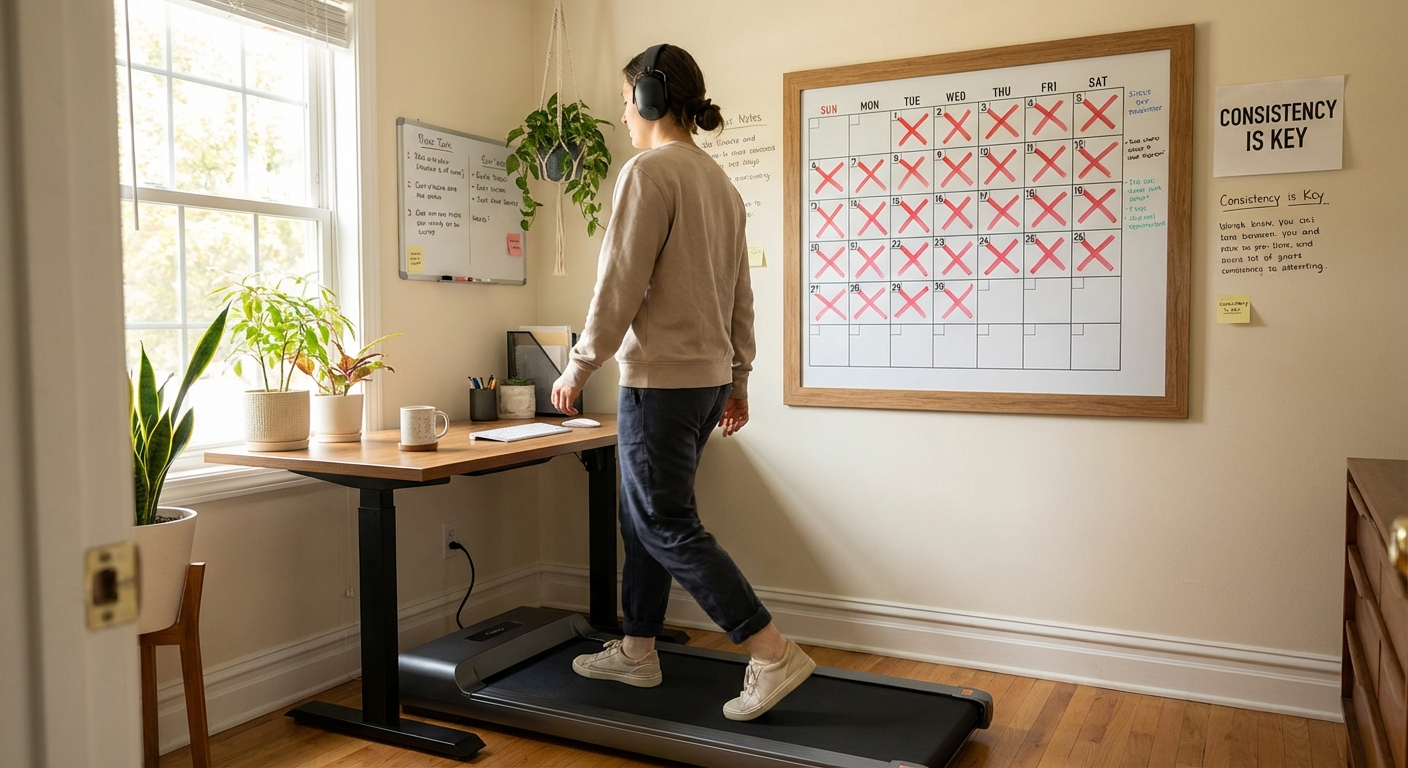 Visual streaks are one of the most powerful behaviour change tools — never break the chain.
Frequently Asked Questions
How long does it take to build a lasting walking pad habit?
Research published in the European Journal of Social Psychology found that habit formation takes an average of 66 days, with a range of 18 to 254 days depending on the individual and behavior complexity. Walking pad use tends toward the shorter end because it pairs easily with existing routines like desk work or watching TV. Most users report the behavior feeling automatic within 4 to 8 weeks of daily practice. The key factor is not duration but consistency — missing a single day does not reset habit formation, but missing two or more consecutive days significantly slows the process.
What is a realistic daily walking pad goal for beginners?
Start with two minutes at 1.5 mph. This sounds trivially easy, and that is the point. The two-minute rule, popularized by James Clear in Atomic Habits, works because it eliminates the psychological barrier to starting. Once you are moving, most sessions extend naturally to 10 to 20 minutes. After one to two weeks of consistent two-minute sessions, increase by five minutes per week until you reach 30 to 45 minutes daily. Progressive scaling prevents the ambition trap that causes most walking pad abandonment.
How do I stay motivated when walking on a pad feels boring?
Pair walking pad time with entertainment you genuinely enjoy but restrict exclusively to walking sessions. This technique, called temptation bundling, creates a positive association where the walking pad becomes the key that unlocks your favorite podcast, audiobook, or TV show. Research from the Wharton School found that participants who bundled tempting audio content with gym visits exercised 29 to 51 percent more often. Also rotate between different entertainment types — podcasts, music playlists, phone calls, and audiobooks — to prevent monotony.
Should I use my walking pad every day or take rest days?
At walking pad speeds of 1.5 to 3.0 mph, daily use is safe and recommended for most healthy adults. Walking at these speeds is low-impact movement, not high-intensity exercise, so it does not require recovery days. The CDC recommends 150 to 300 minutes of moderate-intensity aerobic activity per week, and daily walking pad use fits within those guidelines. If you experience joint discomfort, reduce speed or duration rather than skipping entire days — maintaining the daily cue matters more for habit formation than the session intensity.
What are the best apps for tracking walking pad progress?
Apple Health and Google Fit provide solid baseline step and distance tracking when paired with a smartphone or smartwatch. For dedicated walking pad tracking, Strava and Pacer allow you to log indoor walking sessions and view weekly or monthly trends. Some walking pad brands like WalkingPad and UREVO offer companion apps with built-in session logging. The most important feature for motivation is a visual streak or calendar view — seeing an unbroken chain of daily walks leverages the psychological principle of loss aversion to maintain consistency.
Can I use a walking pad during work meetings and calls?
Yes, and walking meetings are one of the most effective motivation strategies because they attach walking to an immovable part of your schedule. Keep speed at 1.5 to 2.0 mph during calls to avoid audible footsteps on the microphone. Use a directional microphone or headset rather than laptop speakers. Mute when not speaking. Most walking pads produce 35 to 45 dB at walking speeds, which is below the threshold that standard noise-canceling microphones filter out. Remote workers who adopt walking meetings report converting 30 to 60 minutes of previously sedentary time into daily movement without any additional time commitment.
How many calories does daily walking pad use burn per month?
A 160-pound person walking at 2.5 mph for 30 minutes burns approximately 120 calories per session. Over 30 days, that totals roughly 3,600 calories — equivalent to about one pound of body fat. At 45 minutes daily, the monthly total rises to approximately 5,400 calories. While individual session burns appear modest, the cumulative annual effect of consistent daily walking pad use — approximately 43,200 calories at 30 minutes per day — is substantial. Consistency matters far more than per-session intensity for long-term body composition changes.
---## Sources
-
Lally, P., van Jaarsveld, C. H. M., Potts, H. W. W., & Wardle, J. (2010). "How are habits formed: Modelling habit formation in the real world." European Journal of Social Psychology, 40(6), 998-1009. Study establishing the 66-day average for habit formation.
-
Milkman, K. L., Minson, J. A., & Volpp, K. G. M. (2014). "Holding the Hunger Games hostage at the gym: An evaluation of temptation bundling." Management Science, 60(2), 283-299. Research on temptation bundling and exercise adherence from the Wharton School.
-
Clear, J. (2018). Atomic Habits: An Easy & Proven Way to Build Good Habits & Break Bad Ones. Avery. Framework for habit stacking, the two-minute rule, and identity-based habits.
-
U.S. Department of Health and Human Services. (2018). Physical Activity Guidelines for Americans, 2nd edition. CDC recommendation of 150-300 minutes of moderate-intensity aerobic activity per week.
-
Karageorghis, C. I., & Priest, D. L. (2012). "Music in the exercise domain: A review and synthesis." International Review of Sport and Exercise Psychology, 5(1), 44-66. Research on music's effect on perceived exertion and exercise duration.
-
Adriaanse, M. A., Kroese, F. M., Gillebaart, M., & De Ridder, D. T. D. (2014). "Effortful self-control is not the only pathway to successful habit formation." Journal of Personality and Social Psychology, 107(4), 687-700. Study demonstrating that high self-control individuals design environments rather than exerting willpower.
-
IHRSA (International Health, Racquet & Sportsclub Association). (2023). Global Report on Home Fitness Equipment Usage Trends. Consumer behavior data on home fitness equipment abandonment rates.
This article is part of our walking pad motivation series. For related guides, see Best Walking Pad for Apartments, Best Walking Pad for Heavy Users, and Walking Pad vs Standing Desk.