Walking Pad for Kids: Is It Safe? (Parent Guide 2026)
Parents find this article for one of two reasons: either a child wants to use the parent's walking pad, or a parent is considering buying one for a child's fitness. Both questions deserve a direct answer before we get into details.
If your child wants to use your walking pad: Maybe — depending on their age, with strict supervision and speed limits. This guide covers the rules.
If you are thinking of buying a walking pad for a child: Probably not the right solution. Children should be active through play, sports, and outdoor activity — not exercise machines designed for sedentary adults. Walking pads solve an adult problem (not enough movement during desk work). Children do not have this problem.
That said, some situations make walking pad use reasonable for older children — rainy seasons, injury rehabilitation, limited outdoor access. This guide covers those situations too, with safety as the non-negotiable priority.
The Honest Answer: Do Kids Need a Walking Pad?
What Walking Pads Are Designed For
Walking pads exist because adults sit at desks 8–10 hours per day and need a way to add movement without giving up work time. The product solves an adult sedentary problem.
What Children Need Instead
| Activity Type | Examples | Benefit Over Walking Pad |
|---|---|---|
| Free play | Running, climbing, jumping, playground | Develops coordination, balance, bone density, social skills |
| Organized sports | Soccer, basketball, swimming, gymnastics | Cardiovascular fitness, teamwork, discipline |
| Outdoor exploration | Biking, hiking, nature walks | Vitamin D, variable terrain, mental health |
| Active family time | Family walks, bike rides, backyard games | Bonding + fitness simultaneously |
| Unstructured movement | Dancing, tag, jump rope | Joy of movement without structured exercise |
The American Academy of Pediatrics (AAP) recommends 60 minutes of moderate-to-vigorous physical activity daily for children aged 6–17. This should come from varied, enjoyable activities — not from walking at 1.5 mph on a machine.
When a Walking Pad May Be Appropriate for Older Children
| Situation | Age | Reasoning |
|---|---|---|
| Extended bad weather | 12+ | Supplement when outdoor activity is not possible for weeks |
| Injury rehabilitation | 12+ | Under physical therapist guidance; controlled, flat surface |
| Limited outdoor access | 12+ | Urban environments with no safe outdoor walking areas |
| Medical conditions | 10+ (with medical guidance) | Conditions that limit activity type but allow walking |
| Teen desk homework | 14+ | Light walking while studying — same concept as adult desk walking |
Age Guidelines: When Is It Safe?
Age-Based Safety Tiers
| Age Group | Guideline | Supervision Level | Speed Limit |
|---|---|---|---|
| Under 6 | Never — under any circumstances | N/A | N/A |
| 6–8 | Only with direct hands-on supervision | Adult within arm's reach | 0.5–1.0 mph |
| 9–11 | Only with direct supervision | Adult within arm's reach | 0.5–1.5 mph |
| 12–13 | With adult in the room | Adult in same room, attentive | 1.0–2.0 mph |
| 14–15 | With adult in the room | Adult in same room | 1.0–2.0 mph |
| 16–17 | After demonstrating safe use | Initial supervision; then independent | 1.0–2.5 mph |
Why Under 6 Is an Absolute No
| Risk Factor | Child Under 6 |
|---|---|
| Motor coordination | Not developed enough for a moving surface |
| Balance | Insufficiently developed; high fall risk |
| Impulse control | Cannot reliably follow safety rules |
| Size | Small enough to be pulled under/against belt edges |
| Understanding of risk | Cannot comprehend the danger of a powered moving belt |
| Reaction time | Slower than adults; cannot respond to loss of balance |
The CPSC reports that exercise equipment with moving parts is a leading cause of finger amputation and friction burns in children under 5. Walking pads should be treated the same as treadmills in this regard — powered moving belts are dangerous to young children.
Why 6–11 Requires Hands-On Supervision
Children ages 6–11 have sufficient coordination to walk on a flat, slow-moving surface — but they lack the judgment to use the equipment safely without direct adult intervention. They may:
- Increase speed beyond their ability
- Step on the belt while it is at full speed
- Reach down to touch the moving belt
- Trip and not know to step off sideways
- Forget to clip the safety key
An adult within arm's reach can prevent all of these by maintaining physical proximity and control of the speed.
Speed Limits by Age
Why Speed Matters More for Children
Children have shorter legs, lower centers of gravity, and less developed proprioception than adults. A speed that is a comfortable stroll for an adult may be a challenging pace for a child. The belt does not adjust to their stride — they must match it.
Speed Guidelines
| Age | Maximum Speed | Stride Consideration | Risk at Higher Speed |
|---|---|---|---|
| 6–8 | 1.0 mph | Short stride; small steps; belt must move very slowly | Even 1.5 mph may require a jog for short legs |
| 9–11 | 1.5 mph | Growing stride but still shorter than adult; 1.5 mph is a comfortable walk | Above 1.5 mph, shorter children must hurry — increasing fall risk |
| 12–13 | 2.0 mph | Approaching adult stride; 2.0 mph is a comfortable walk | Above 2.0 mph may require running for some 12-year-olds |
| 14–15 | 2.0 mph | Near-adult stride; moderate walking pace | Low risk at walking speeds |
| 16–17 | 2.5 mph | Adult stride; standard walking guidelines apply | Same risk profile as adults |
The Critical Speed Rule
The child should never walk faster than they can safely stop and step off without stumbling. Test this at low speed before increasing: at their current speed, can they stop walking, stand still on the moving belt momentarily, and step off to the side without losing balance? If yes, the speed is safe. If no, reduce speed by 0.5 mph.
Supervision Requirements
Direct Supervision (Ages 6–11)
| Requirement | What It Means |
|---|---|
| Adult within arm's reach | Standing next to the walking pad — not sitting across the room |
| Adult controls speed | The adult holds the remote or is positioned at the console; the child does not change speed |
| Safety key on child | The safety key clip is attached to the child's clothing at all times |
| No distractions for supervisor | No phone scrolling, no cooking, no working — attention on the child |
| Session time limits | 10–15 minutes maximum per session for ages 6–8; 15–20 minutes for ages 9–11 |
| Adult initiates and stops | The adult starts the belt at minimum speed; the child does not start the machine |
Room Supervision (Ages 12–15)
| Requirement | What It Means |
|---|---|
| Adult in the same room | Able to see the child and reach the walking pad within seconds |
| Child trained on safety | Child has been taught: safety key use, how to stop, how to step off, speed limits |
| Safety key on child | Always — non-negotiable at any age |
| Child may adjust speed | Within agreed limits (e.g., "you can go up to 2.0 mph, no faster") |
| Session time limits | 20–30 minutes maximum |
Independent Use (Ages 16+, After Training)
| Requirement | What It Means |
|---|---|
| 5–10 supervised sessions first | Adult observes that the teen uses the pad safely and consistently |
| Safety key always worn | Non-negotiable — even for teens, even when it feels unnecessary |
| House rules posted | Speed limit, time limit, footwear requirement — posted near the walking pad |
| Someone knows you are walking | Teen should not walk on the pad when home alone without someone knowing |
Injury Risks: What Can Go Wrong
Common Treadmill/Walking Pad Injuries in Children
| Injury Type | How It Happens | Severity | Prevention |
|---|---|---|---|
| Friction burns | Skin contacts the moving belt during a fall — knees, palms, face | Moderate to severe | Safety key stops belt; proper clothing; adult supervision |
| Finger entrapment | Small fingers inserted between belt and pad edge or underside | Severe | Never let children play near a running pad; childproof when off |
| Falls (on belt) | Loss of balance; speed too high; stepping on at speed | Mild to moderate | Age-appropriate speed; adult starts belt at minimum; safety key |
| Falls (off back) | Walking pad ejects the child backwards off the end | Moderate | Clear space behind pad; safety key; speed limits |
| Clothing entrapment | Loose shorts, drawstrings, untied shoelaces caught in belt | Moderate to severe | Fitted clothing; tied shoes; no drawstrings near belt |
| Hair entrapment | Long hair caught in belt edge or roller mechanism | Severe | Hair tied back; never bend down near running belt |
| Impact with furniture | Ejected from pad into nearby furniture or wall | Moderate | 3+ feet of clear space behind and beside the pad |
CPSC Data Context
The Consumer Product Safety Commission reports approximately 22,000 treadmill-related emergency room visits per year in the United States. Children under 15 account for approximately 10% of these — roughly 2,200 annual ER visits. The most common injuries in children are friction burns and finger entrapment. Walking pads share the core hazard mechanism (powered moving belt) and should be treated with the same caution.
Essential Safety Features for Child Use
Must-Have Features
| Feature | Why Essential for Kids | What to Check |
|---|---|---|
| Safety key clip | Instant belt stop if child falls or stumbles — the single most important feature | Clip attaches to clothing; pulling it kills the motor within 1–2 seconds |
| Auto-stop sensor | Belt stops when user steps off — backup safety | Test by stepping off at low speed; belt should stop within 3 seconds |
| Low minimum speed (0.5 mph) | Allows the gentlest introduction; children can walk very slowly while building confidence | Check specs — some walking pads start at 0.6–1.0 mph (too fast for young users) |
| Remote control | Adult controls speed from beside the pad; can stop instantly | Remote must have a clear stop button; not just speed down |
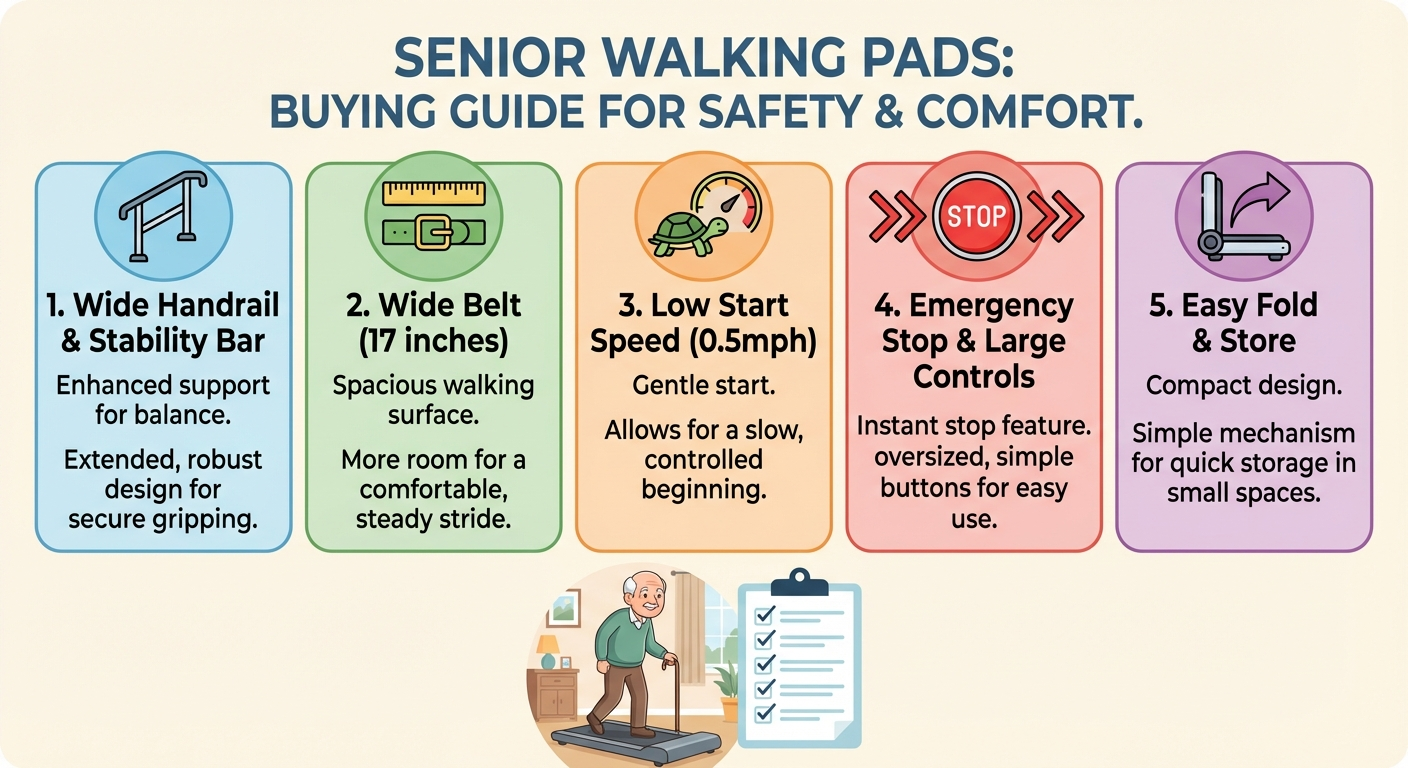
| Wide belt (16"+) | Children's gaits are less precise; wider belt reduces step-off risk | Measure or check specs; 17" is ideal |
Nice-to-Have Features
| Feature | Benefit for Child Safety |
|---|---|
| Speed lock | Some models allow setting a maximum speed — prevents child from increasing beyond limit |
| Gradual speed start | Belt accelerates slowly from 0 to set speed — no sudden start |
| Low step-on height | Easier for children to step on and off safely |
| Clear display | Child can see their speed; adult can verify from across the room |
Disqualifying Features (Do NOT Use These with Kids)
| Feature | Why It Is Dangerous for Children |
|---|---|
| Foot-sensing speed control | Speed changes based on foot position — unpredictable for children |
| No safety key | No emergency stop mechanism — unacceptable for child use |
| High minimum speed (1.0+ mph) | Too fast for initial familiarization, especially for ages 6–8 |
| Small belt width (under 15") | Insufficient margin for a child's less precise foot placement |
Walking Pad Safety Rules for Kids
Rules to Post Near the Walking Pad
Print these and tape them to the wall next to the walking pad:
Before Walking:
- Always wear sneakers — never bare feet, socks, or sandals
- Tie all shoelaces; tuck in drawstrings; tie back long hair
- Clip the safety key to your shirt — every single time
- An adult must be present (ages 6–15)
- Stand on the belt before it starts — never jump onto a moving belt
While Walking: 6. Walk — never run, skip, or play on the walking pad 7. Look forward — not at your feet, not at a phone 8. Stay in the center of the belt 9. Do not touch the belt edges or reach underneath 10. If you feel dizzy or off-balance, grab the safety key or step off to the side
After Walking: 11. Press stop and wait for the belt to fully stop before stepping off 12. Unplug the walking pad after every session (if young children are in the home)
Models with the Best Safety Features
Walking Pads with Safety Key + Auto-Stop
| Model | Safety Key | Auto-Stop | Min Speed | Belt Width | Price | Notes |
|---|---|---|---|---|---|---|
| Goplus 2-in-1 | ✅ | ✅ | 0.5 mph | 16" | ~$210 | Handrail for balance support; best safety feature set |
| REDLIRO Folding | ✅ | ✅ | 0.5 mph | 16.5" | ~$250 | Foldable handrail; cushioned deck |
| UMAY Under Desk | ❌ | ✅ | 0.6 mph | 16" | ~$200 | No safety key — less suitable for younger children |
| Sperax | ❌ | ✅ | 0.5 mph | 17" | ~$270 | Widest belt; no safety key |
| WalkingPad C2 Mini | ❌ | ✅ | 0.5 mph | 16" | ~$250 | Compact; no safety key |
Best Choice for Households with Children
The Goplus 2-in-1 is the most child-appropriate walking pad because it has all three critical safety features: safety key clip, auto-stop sensor, and a handrail for balance support. The handrail is particularly valuable for children, who benefit from the same balance support that makes it ideal for seniors. See our best walking pad for seniors guide for detailed safety feature analysis.
For households where a child may occasionally use the parent's walking pad, the safety key is the non-negotiable feature. Models without a safety key (UMAY, Sperax, WalkingPad) require extra caution — the adult must hold the remote and be ready to hit stop instantly.
What Pediatric Guidelines Say
AAP Physical Activity Recommendations
The American Academy of Pediatrics recommends:
| Age Group | Daily Activity | Type | Equipment Needed |
|---|---|---|---|
| 3–5 years | Active throughout the day | Unstructured play | None — play is the exercise |
| 6–17 years | 60 minutes moderate-to-vigorous | Mixed — aerobic, muscle, bone | Minimal — sports, playground, outdoors |
Walking on a machine at 1.5 mph is not moderate-to-vigorous activity for most children. It is light activity — better than sitting, but not a replacement for the running, jumping, and playing that children's bodies need for proper development.
Pediatric Exercise Equipment Guidance
| Source | Recommendation |
|---|---|
| AAP | Children should achieve fitness through active play and sports, not exercise machines |
| CPSC | Exercise equipment with moving parts should be kept away from young children; supervised use only for minors |
| ACSM | Youth exercise should focus on skill development, enjoyment, and varied activities |
The Pediatric Perspective
Most pediatricians would not recommend purchasing a walking pad specifically for a child. The recommendation would be:
- More outdoor time
- Enrollment in a sport or activity
- Family walks together
- Reduced screen time (which creates the inactivity problem)
A walking pad is a tool for adults who cannot move enough during their workday. Children do not have this constraint — their constraint is typically too much screen time and too little outdoor activity, neither of which a walking pad addresses effectively.
Childproofing When Not in Use
Why Childproofing Matters
Young children (especially ages 1–5) are drawn to walking pads and treadmills. The belt, the buttons, the movement — it is fascinating to a toddler. The CPSC specifically warns about children accessing powered exercise equipment unsupervised.
Childproofing Steps
| Step | Method | Priority |
|---|---|---|
| Unplug after every use | Pull the power cord from the wall outlet — not just turn off | Essential |
| Store cord out of reach | Wrap around the machine or coil on a high shelf | Essential |
| Block access if possible | Close the door to the room with the walking pad; use a baby gate | High |
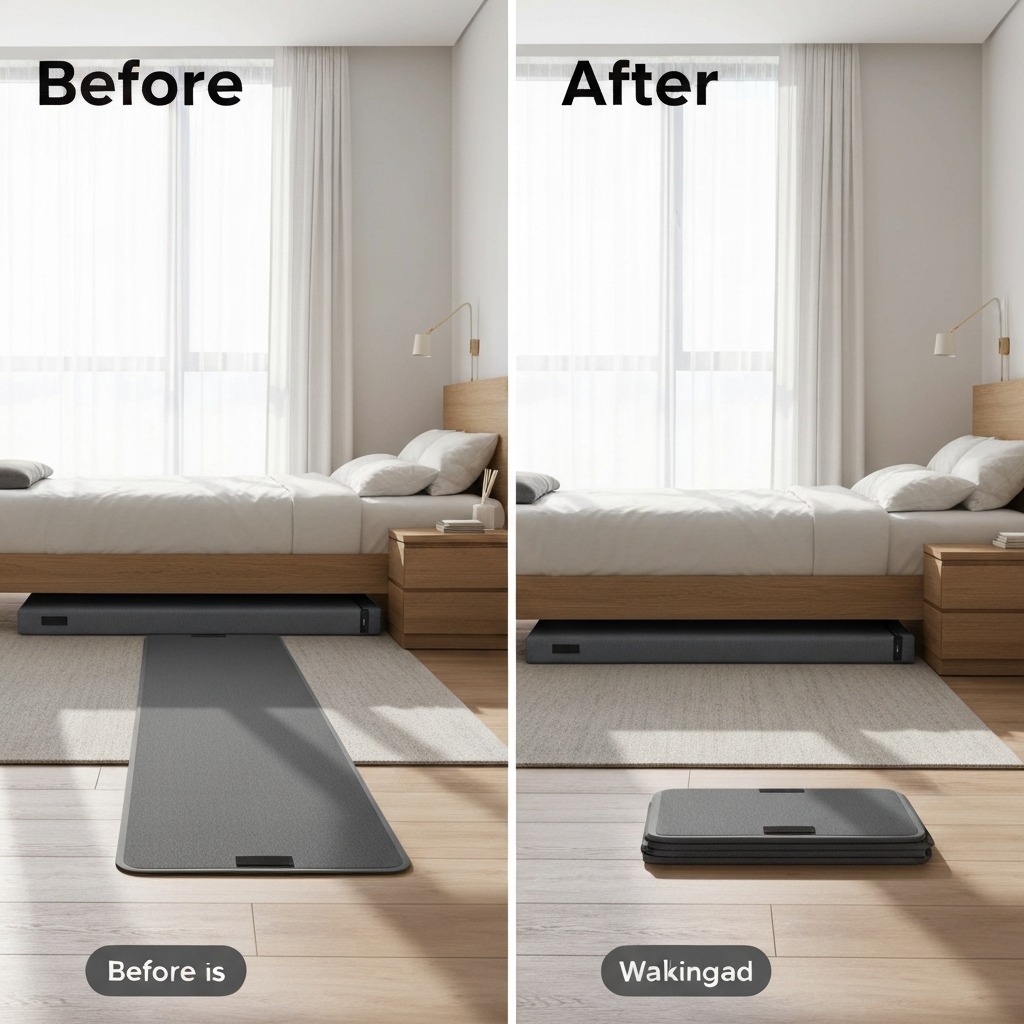
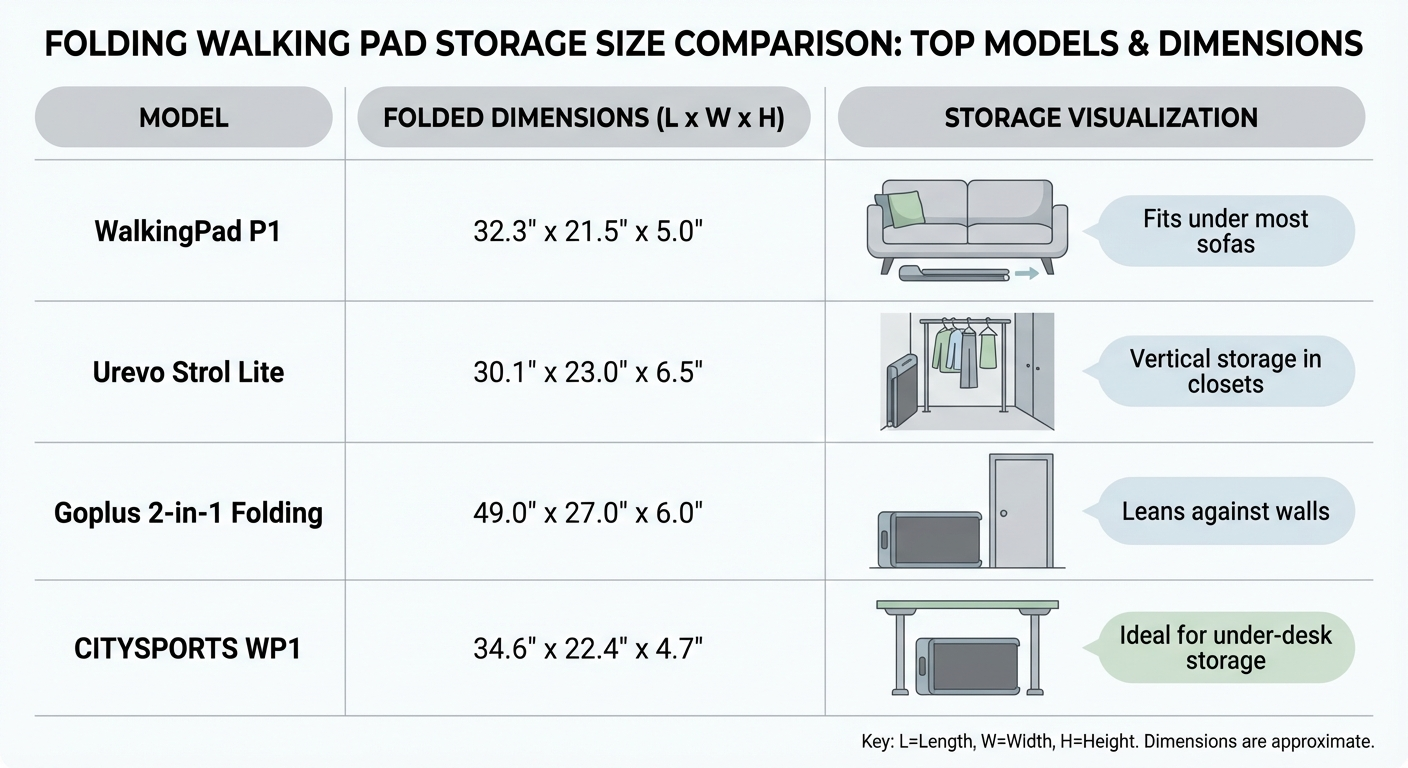
| Fold and store | Foldable pads can be stored upright against a wall or in a closet | High |
| Explain the danger | Age-appropriately tell children that the walking pad is not a toy | Medium |
| Remove the safety key | Keep the safety key in a drawer — without it, some models will not start | Medium |
| Use the parental lock | If the model has a lock code, enable it | Medium |
The Non-Negotiable Rule
A walking pad should never be accessible to unsupervised young children in a powered state. Unplugging is the most reliable childproofing method — no child can accidentally start an unplugged machine.
Frequently Asked Questions
What age can kids use a walking pad?
Most manufacturers set a minimum of 12–16 years. With direct adult supervision: ages 6–11 at 0.5–1.5 mph. Under 6: never, under any circumstances.
Are walking pads safer than treadmills for kids?
Somewhat — lower max speed (3.5–4 mph vs 10–12 mph), lower belt height, no incline. But the core risk (powered moving belt) is the same. Walking pads are not toys.
What speed should kids walk?
Ages 6–8: max 1.0 mph. Ages 9–11: max 1.5 mph. Ages 12–15: max 2.0 mph. Ages 16+: up to 2.5 mph. Never faster than they can safely step off without stumbling.
Do I need to supervise?
Always for under 16. Ages 6–11: adult within arm's reach. Ages 12–15: adult in the same room. Ages 16+: after 5–10 supervised sessions demonstrating safe use.
What safety features are essential?
Safety key clip (most important — instant belt stop), auto-stop sensor, low minimum speed (0.5 mph), wide belt (16"+), and remote control for the supervising adult.
Can toddlers use a walking pad?
No — never. Children under 6 lack the motor coordination, balance, and impulse control for a powered moving surface. Unplug and childproof when not in use.
What injuries happen to kids?
Friction burns from belt contact during falls, finger entrapment in belt edges, falls from loss of balance or being ejected off the back, and clothing/hair entrapment. Prevention: safety key, proper footwear, fitted clothing, supervision, and age-appropriate speed.
Should I buy one for my child?
In most cases, no. Children should be active through play, sports, and outdoor activity. Walking pads solve an adult sedentary problem. Exceptions: older children (12+) during injury rehab, extreme weather periods, or limited outdoor access — always as a supplement, not a primary activity source.
Sources and Methodology
This guide provides safety information for parents considering walking pad use by children, based on manufacturer guidelines, government safety data, and pediatric exercise recommendations.
Safety References:
- Consumer Product Safety Commission (CPSC): Treadmill safety warnings and injury data — approximately 22,000 annual ER visits; children under 15 account for ~10% — cpsc.gov
- CPSC: Exercise equipment hazards to children — finger entrapment, friction burns, and moving-parts warnings
- Walking pad and treadmill manufacturer user manuals: minimum age specifications (typically 12–16 years)
Pediatric Health References:
- American Academy of Pediatrics (AAP): Physical Activity Guidelines — 60 minutes daily moderate-to-vigorous activity for ages 6–17; active play emphasized over exercise machines — aap.org
- CDC: Physical Activity Guidelines for Americans — youth recommendations — cdc.gov
- ACSM: Youth Exercise Guidelines — skill development, enjoyment, and varied activities
Methodology notes:
- Age thresholds are based on manufacturer minimum age specifications, CPSC injury data patterns, and developmental milestones for coordination, balance, and impulse control
- Speed recommendations are based on stride length relative to age, coordination development, and the principle that walking speed should never exceed the child's ability to safely stop and step off
- Supervision levels are tiered by developmental capacity for judgment, rule-following, and self-monitoring
- This guide provides safety information, not medical advice. Consult your child's pediatrician before allowing use of exercise equipment
- Specific injury statistics are from CPSC annual reports on exercise equipment injuries; walking pad-specific data is limited as a newer product category
- We may earn a commission on purchases at no additional cost to you; affiliate relationships do not influence recommendations
Internal links referenced:
Visual Guide Gallery